Most UK address lookup APIs answer one question: what is the correct postal address for this text? Property workflows need a second answer: which property is this, and what do we know about it?
The gap between the two is an identifier. Royal Mail's Postcode Address File gives you a UDPRN for each delivery point. Ordnance Survey's address data gives you a UPRN for each addressable location. Property data, from titles to EPCs to sales, hangs off those identifiers.
So which lookup do you need, what sits behind each one, and how do you get from typed text to a full property record in two calls?
What is the difference between address lookup, postcode lookup and property data lookup?
They solve three different problems, and many products combine the first two.
| Postcode lookup | Address lookup | Property data lookup | |
|---|---|---|---|
| Input | A postcode | Partial or full address text | An identifier (UPRN, UDPRN or provider ID) |
| Output | Addresses at that postcode, sometimes coordinates and admin areas | A validated, formatted address and its identifiers | Tenure, title, EPC, sales history, valuation, risk data |
| Typical use | Checkout and form fill | Data cleansing, onboarding, matching | Underwriting, due diligence, prospecting, analytics |
| Main source | Royal Mail PAF | PAF or OS AddressBase | Many datasets joined on the identifier |
A postcode lookup API is the familiar "enter your postcode, pick your address" pattern. It is fast and cheap, and it ends at the address.
An address lookup API takes messy text ("flat 2 10 high st") and resolves it to a canonical address. For property work, the identifier in the response matters more than the formatted string.
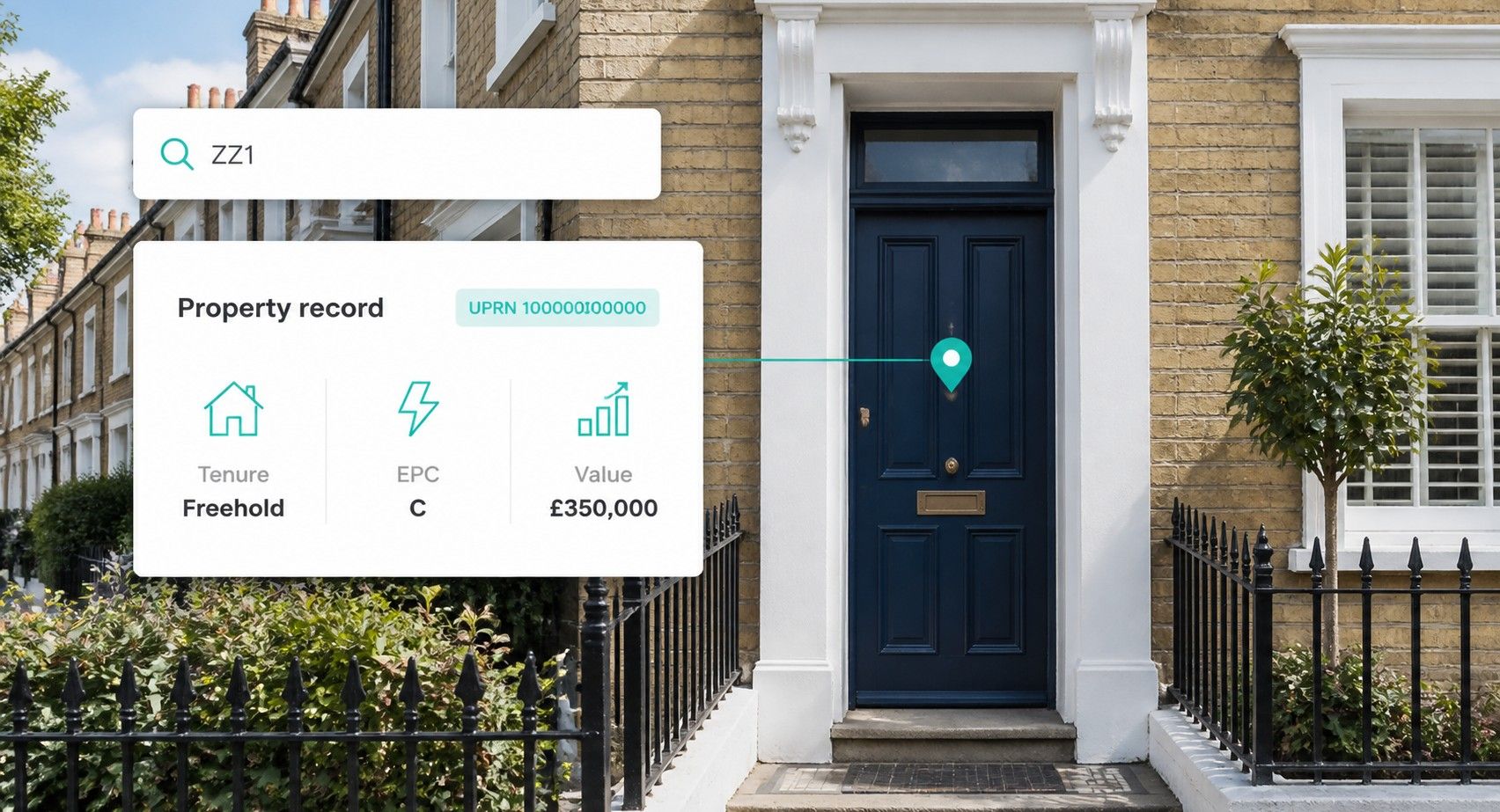
A property data lookup starts where address lookup ends. Given a UPRN, it returns what the address alone cannot, from tenure and title to the material information a property listing needs.
Where does UK address data come from?
Two families of data sit behind almost every UK address API.
- Royal Mail Postcode Address File (PAF). Ordnance Survey describes PAF as holding "over 30 million UK postal addresses", with between 3,000 and 5,000 changes made every day. Each delivery point carries a UDPRN, which the PAF glossary defines as "an 8-character code". PAF is a postal file: it lists where mail is delivered.
- Ordnance Survey AddressBase. OS address products carry the UPRN and cover addressable locations beyond postal ones. OS Places API searches AddressBase Premium and AddressBase Premium Islands, covering the UK, Jersey, Guernsey and the Isle of Man, and is updated daily.
One date to note for anyone building now. Ordnance Survey's end of life notices set 29 November 2027 for AddressBase and AddressBase Plus. OS points users to the GB Address Collection of the OS NGD Address Theme, with an Islands Address Collection for Northern Ireland, the Isle of Man and the Channel Islands.
For open identifiers, OS Open UPRN publishes every UPRN with its coordinates in CSV and GeoPackage, including demolished and under-construction records. It carries no address text, so on its own it cannot turn an address into a UPRN.
How do UPRN and UDPRN differ, and why match to both?
A UPRN identifies a location. A UDPRN identifies a letterbox. For a standard house the two point at the same home. For conversions, unbuilt plots and subdivided units they diverge.
- UPRN. Created by Ordnance Survey, up to 12 digits, and endorsed by the government's Data Standards Authority as the open standard for identifying property, under the Open Government Licence v3.0. It stays with the location for its lifetime and exists for things that never get post, such as plots and substations.
- UDPRN. Royal Mail's delivery point reference. PAF flags "Multiple Residence" premises, where several households share one letterbox, which is exactly where one UDPRN can cover several homes with their own UPRNs.
A real lookup shows why. In October 2026, a Propalt address lookup for one converted house in Leeds returned ten separate property records: one for the building and nine for flats within it, including both a 10 and a 10a. Each unit is its own property record and can carry its own EPC and sales history.
Matching to both matters because different datasets arrive keyed differently. Some sources key on UPRN, others on postal address or UDPRN. Our explainer What is a UPRN? covers the identifier in depth.
Address lookup gives you a clean string. The identifier is what lets you join a title, an EPC and a sale to the same building.
What should you look for in an address lookup API?
Five questions separate a form-fill widget from an address API you can build property products on.
- Coverage. Great Britain or the whole UK? Islands? New-build plots before they get a postal address? A PAF-only service will miss addressable locations that have no delivery point yet.
- Update frequency. OS Places is updated daily. Ask your provider how quickly a new PAF or AddressBase release reaches their index, and whether retired addresses stay searchable.
- Identifiers returned. UPRN, UDPRN, both, or only a provider ID? If you cannot get a UPRN out, every later join depends on that provider.
- Licence terms. Royal Mail licenses PAF through Solutions Providers and direct end users, with transactional (pay as you go), per-user and unlimited options; microbusinesses with fewer than 9 employees and under £2m turnover can register for free use under the Developer and Microbusiness terms. Check whether your use case (internal, customer-facing, resale) is covered and who reports the licence fees.
- Pricing per lookup. Compare the cost per successful resolution as well as the price per call. A cheap lookup that returns three candidates and no identifier costs you a second call and a manual review.
Add one property-specific test: take 100 addresses from your own book, including flats, conversions and rural properties, and measure how many resolve to a single UPRN. Our buyer's guide to UK property data APIs covers the questions to ask once you move beyond addresses.
How do you resolve an address and then fetch property data?
With a property data API, address resolution and property lookup run in sequence against one service. The example uses the Propalt API at https://api.propalt.io with placeholder values.
Propalt's address lookup accepts a full postcode, an outward code, a local authority name or free-text address. It decides the search strategy from the input and returns typed results: an address result carries a Propalt property ID for an exact property, while postcode, first_postcode and authority results identify areas. A separate street lookup handles road-level queries.
import requests

BASE = "https://api.propalt.io"
HEADERS = {"Authorization": "Bearer YOUR_API_KEY"}

# 1. Resolve free text to a property
hits = requests.get(f"{BASE}/location-search/address-lookup",
                    params={"keyword": "1 Example Road, AB1 2CD"},
                    headers=HEADERS).json()

exact = [h for h in hits["data"] if h["type"] == "address"]
if len(exact) != 1:
    raise ValueError("Ambiguous or no match: ask the user to pick")
property_id = exact[0]["property_id"]

# 2. Fetch the property record by ID (or by uprn / udprn, one per call)
prop = requests.get(f"{BASE}/property/get-property",
                    params={"property_id": property_id},
                    headers=HEADERS).json()

print(prop["uprn"], prop["address_text"], prop["tenure"],
      prop["title_number_list"], prop["current_energy_rating"], prop["avm"])
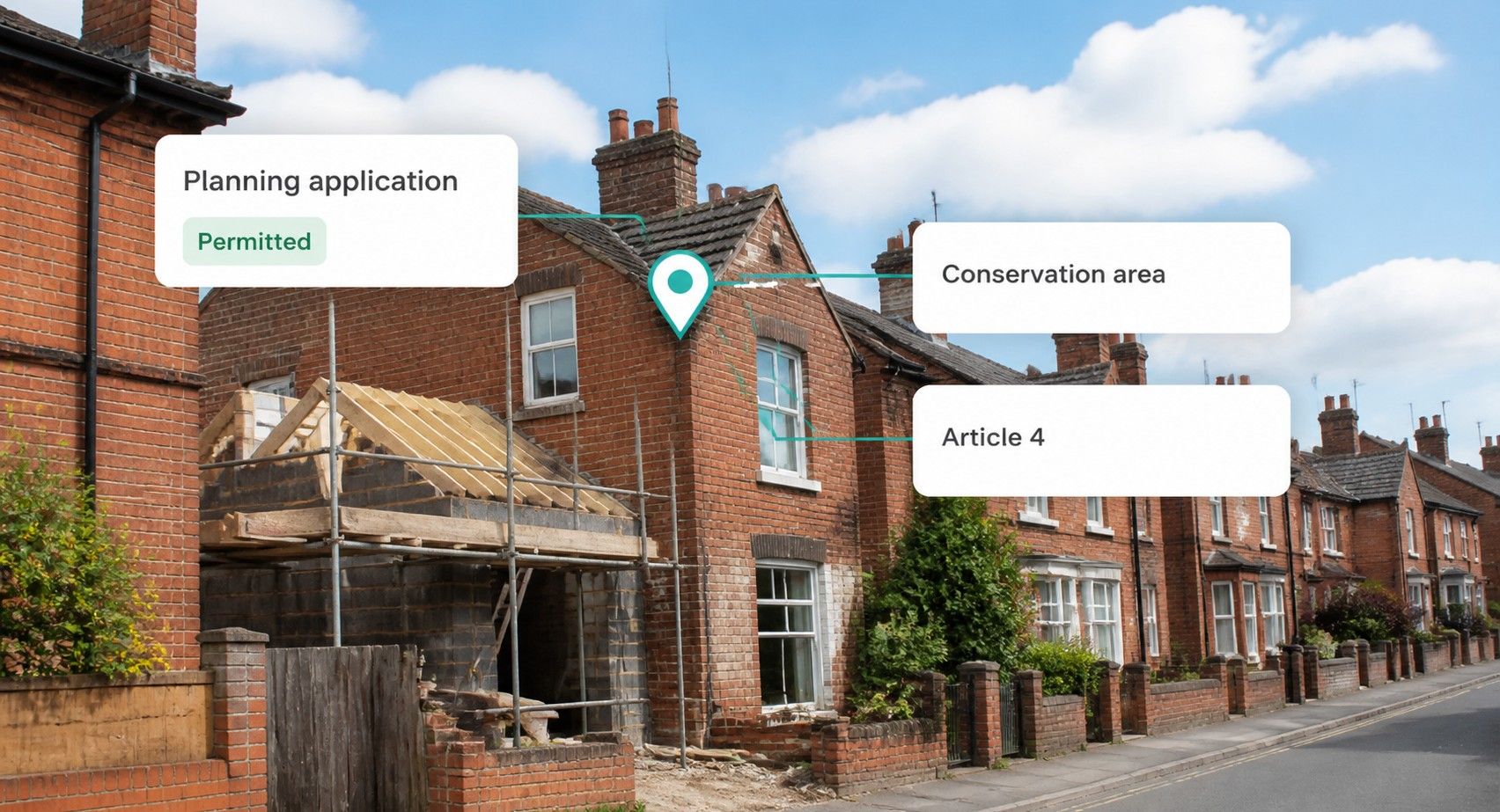
The property call returns the UPRN, address text, tenure, title numbers, property type, current energy rating and Propalt's AVM. Title numbers are the starting point for finding out who owns a property. From the same identifier you can add planning applications and constraints, coal and mining areas, broadband, crime, demographics, schools, transport, EPC fabric and comparables. The same flow runs through the Propalt MCP server in Claude or ChatGPT, where you type the address and the model handles both steps, on credit-based plans with a free allowance. Our UK property data API developer guide covers getting started.
📌 KEY TAKEAWAY
A postcode lookup API fills a form, an address lookup API returns a clean address, and a property data lookup turns that address into tenure, title, EPC and value. The UK address API market rests on Royal Mail PAF (UDPRN) and Ordnance Survey AddressBase (UPRN). Judge any provider on coverage, update frequency, identifiers returned, licence terms and cost per resolved property, and propalt.ai resolves the address and returns the property record by UPRN through one API or MCP.
SOURCES & DATA REFERENCES
- Ordnance Survey (accessed October 2026). 'What is the Royal Mail Postcode Address File?' Over 30 million UK postal addresses; 3,000 to 5,000 changes a day. ordnancesurvey.co.uk/blog/royal-mail-postcode-address-file
- Royal Mail, Powered by PAF (accessed October 2026). 'About PAF licencing.' Solutions Providers, direct end users, transactional, per-user and unlimited options, microbusiness free use. poweredbypaf.com/about-paf-licencing
- Royal Mail, Powered by PAF (accessed October 2026). 'Glossary.' UDPRN as an 8-character code; Multiple Residence definition. poweredbypaf.com/glossary
- Ordnance Survey, OS Docs (accessed October 2026). 'End of Life Notice: AddressBase' and 'End of Life Notice: AddressBase Plus.' Both end of life on 29 November 2027; replacement is the GB Address Collection of the OS NGD Address Theme. docs.os.uk/os-downloads/resources/product-resources/end-of-life-product-notices/end-of-life-notice-addressbase-plus. Islands Address Collection: OS Docs, 'Comparison of End of Life Address Products', docs.os.uk/more-than-maps/os-ngd-migration/comparison-of-end-of-life-address-products
- Ordnance Survey, OS Docs (accessed October 2026). 'OS Places API.' Uses AddressBase Premium and Premium Islands, UK and Crown Dependencies coverage, daily updates, find, nearest and UPRN search. docs.os.uk/os-apis/accessing-os-apis/os-places-api
- Ordnance Survey, OS Docs (accessed October 2026). 'OS Open UPRN overview.' UPRN with coordinates, CSV and GeoPackage, all lifecycle states, no address text. docs.os.uk/os-downloads/identifiers/os-open-uprn
- Data Standards Authority, GOV.UK (accessed October 2026). 'Identifying property and street information: UPRN.' Up to 12 digits, created by OS, endorsed open standard, OGL v3.0. alphagov.github.io/data-standards-authority/standards/UPRN
- Propalt (October 2026). 'Address lookup and property record behaviour: input types, typed results, property fields.' API example description. propalt.ai (Propalt API / MCP)
- Propalt (October 2026). 'Address lookup, one converted house in Leeds.' Ten property records returned: one for the building and nine for flats within it, including units 10 and 10a. Propalt MCP, address_lookup
Contains HM Land Registry data © Crown copyright and database right 2026. This data is licensed under the Open Government Licence v3.0.