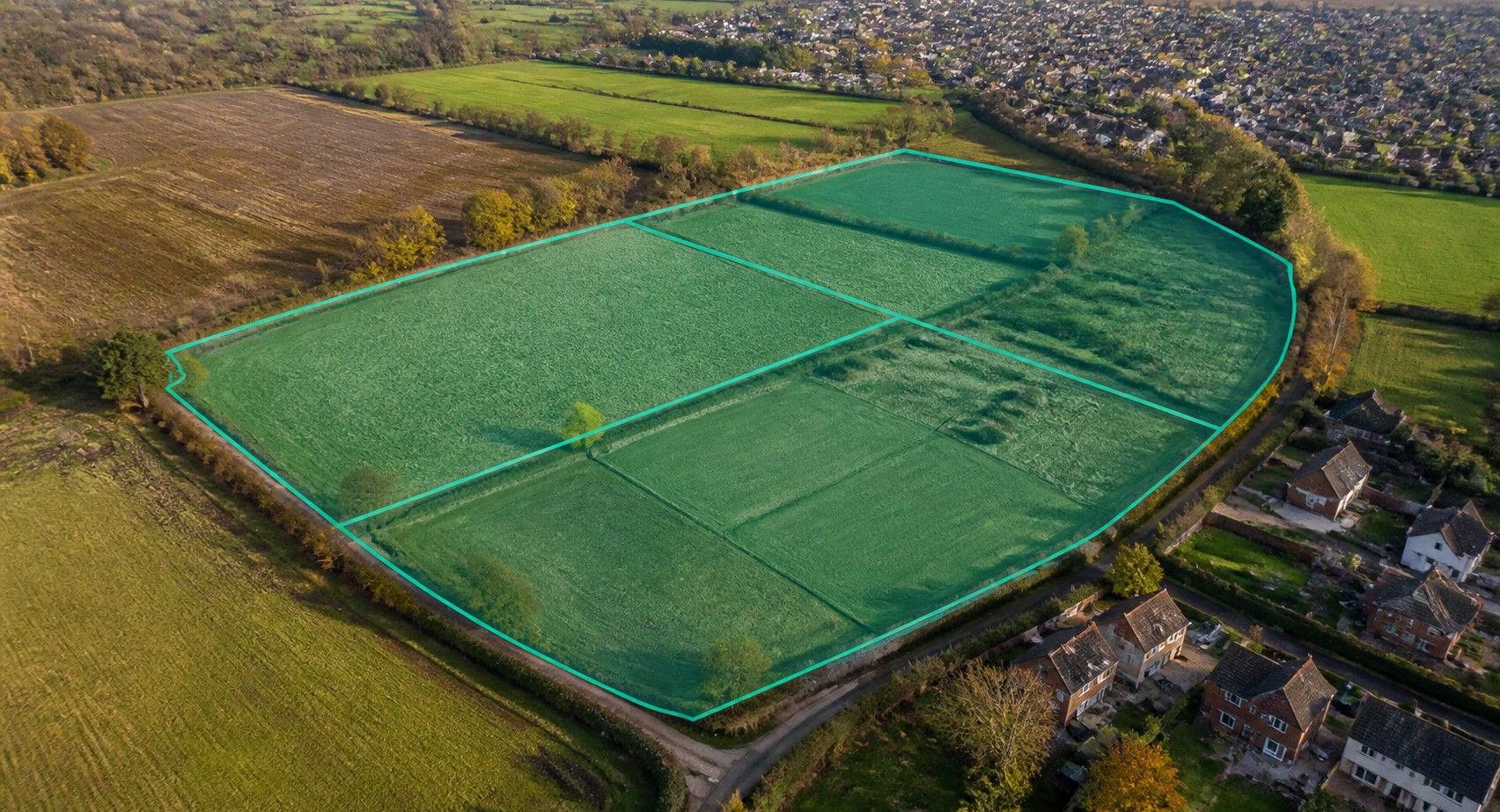
Land assembly is the work of bringing adjoining parcels in separate ownership under one control so they can be developed as a single site. Two back gardens and a garage block may each be too small to build on. Together, with an access point, they may take a terrace of houses.
The combined site is often worth more than the parcels added up, which is the reason to assemble it. It is also the reason owners late in the process hold out for more. Each title you secure raises the value of the ones you have not.
Most of the risk sits in what you do not know at the start: who owns each piece, whether any strip controls the access, and what planning will allow. What data do you need before the first approach letter goes out?
What is land assembly?
Land assembly, also called site assembly, is acquiring or controlling several neighbouring interests so that one scheme can go ahead across all of them. The interests can be freeholds, leaseholds, rights of way or small pieces of unregistered land.
Control does not always mean purchase. Developers often sign conditional contracts, options or promotion agreements with each owner, then buy only when planning permission is in place. The aim is to avoid owning half a site that cannot be built.
Why do ransom strips matter so much?
A ransom strip is a piece of land, often narrow, that sits between a development site and the road or services it needs. Whoever owns it can block access, so they can ask for a share of the value the development creates.
A figure of one third of the uplift is often quoted, from Stokes v Cambridge Corporation (1961). DAC Beachcroft calls this a myth. Each case turns on its facts.
The practical lesson is to find ransom positions before you price the site. A strip you discover after exchange on the main parcel is the most expensive kind.
In land assembly, the smallest title on the plan can set the price of the largest.
How do you map ownership across several parcels?
Work from the map to the titles, then from the titles to the owners. In England and Wales, a typical sequence looks like this:
- Draw the site. Mark the boundary you want, including access and visibility splays.
- Overlay INSPIRE Index Polygons. HM Land Registry (HMLR) publishes these free each month under the Open Government Licence. Each shows the indicative extent of a registered freehold and carries an INSPIRE ID. They are not title boundaries, and HMLR says the extent of a title cannot be established from them.
- Look for gaps. Land with no polygon may be leasehold only, or unregistered. A search of the index map (SIM) costs £8 for up to five titles, as of October 2026, and confirms what is registered.
- Buy the registers and plans. Each title register and title plan costs £7 to download. The register names the owner, any mortgage lender and the covenants and easements; the plan shows general boundaries.
- Read across titles. Rights of way, restrictive covenants and charges on one title can affect the whole scheme.
Professionals with an HMLR portal account can also use MapSearch, a free service showing registration status, title number and tenure.
Through the Propalt MCP, a property lookup by address or UPRN returns its tenure and the title numbers recorded against it, so you know which registers to buy before you spend on them.
For a full guide to each ownership route, including unregistered land, Scotland and Northern Ireland, see How to Find Out Who Owns a Property or Land in the UK.
How do you find out who is behind a company-owned parcel?
Check whether the owner on the register is a company. HMLR's monthly CCOD file lists titles owned by UK companies with their registration numbers, and OCOD does the same for overseas companies with country of incorporation. Both are free with an account and licence.
Search each company on Companies House to find its directors and related companies. Since 1 August 2022, overseas entities owning UK land have had to register their beneficial owners at Companies House, which helps when an offshore vehicle holds a parcel you need. Our article on whether a property is owned by a limited company explains why a company search can look complete when it is not.
How should you approach multiple owners?
There is no fixed method, but a few principles apply to most schemes.
- Start with the parcels that control access. Securing the ransom position first takes away the strongest holdout.
- Keep terms consistent. Owners talk to each other. Very different offers for similar land usually come back to you.
- Use conditional deals. Agreements subject to planning let you commit before you spend on land you may not use.
- Know the planning notice rules. You can apply for planning permission on land you do not own. Under section 65 of the Town and Country Planning Act 1990, the application must carry an ownership certificate. Where others own part of the site, you must serve notice on everyone who was an owner 21 days before the application date (Certificate B), or advertise if some owners cannot be found (Certificates C and D). Owners will learn about the scheme at that point if they have not already.
What are option and promotion agreements?
They are the two most common ways to control land without buying it outright. This is a general description, not legal advice; each agreement is negotiated and needs specialist solicitors on both sides.
| OPTION AGREEMENT | PROMOTION AGREEMENT | |
|---|---|---|
| Structure | Developer has the right, but not the obligation, to buy within a set period | Promoter seeks planning, then the land is sold on the open market |
| Price | Pre-agreed or a percentage of market value when exercised | Sale proceeds split on agreed terms after costs |
| Upfront | Developer usually pays a fee for exclusivity | Promoters often carry planning costs and risk |
| Owner's position | Less control over timing; no competitive bidding | More involvement in sale timing and strategy |
On assembled sites, owners of different parcels may sign different structures, and the deals have to fit together: an option over the access parcel that expires before the promotion agreement on the main field secures planning leaves you exposed. Ask your solicitors to align the long-stop dates.
Where does compulsory purchase fit?
Only as background for most private developers. Compulsory purchase powers belong to public bodies such as councils, and an order must be confirmed, usually by the Secretary of State in England or Welsh ministers in Wales. An acquiring authority can confirm its own order where no objections remain, and since 18 February 2026 the Planning and Infrastructure Act 2025 lets it do so with limited modifications.
The Levelling-up and Regeneration Act 2023 added a power to remove hope value from compensation in certain cases. With a direction, land is valued as if no new planning permission would be granted. It is limited to schemes such as those including public sector-led affordable or social housing, NHS purposes and education, and the authority must show compelling public interest reasons. The Planning and Infrastructure Act 2025 extends the power to town, parish and community councils acquiring land for affordable or social housing. For a developer, the practical relevance is mostly where a council is assembling land for a regeneration scheme you are part of.
What data stack does land assembly need?
Land sourcing can do much of its early filtering on data before anyone visits a site. The useful layers are:
- Ownership. Title numbers, tenure and registered owners for every parcel, linked to the address and UPRN where one exists.
- Company ownership. Which parcels sit with companies, and which companies hold other land nearby.
- Land classification. Non-residential parcels such as open land, yards and unused plots, which residential searches miss.
- Planning history. Past applications on and near each parcel show what has been refused, approved or tried before, and the ownership certificates name owners.
- Planning constraints. Conservation areas, heritage designations, flood zones and protected areas can remove units or kill a scheme. For residential conversions, Article 4 directions matter too, as our piece on underwriting in an Article 4 area shows.
Each of these comes from a different publisher with a different identifier, which is why joining them is most of the work. Our guide to HMLR property data and APIs sets out what each HMLR dataset covers and how it is licensed.
Our guide to the planning data API covers the planning layers in more depth. Once the site is under control, the scheme's gross development value sets what you can pay for it, and in the Green Belt the grey belt test can open a route to housing.
📌 KEY TAKEAWAY
Land assembly succeeds or fails on what you learn before the first approach: who owns every parcel, which strip controls access, and what planning will allow. Map titles with INSPIRE polygons and £7 title plans, confirm gaps with a search of the index map, trace company owners through CCOD, OCOD and Companies House, and treat the one-third ransom figure as a starting myth rather than a rule. Control the land with conditional deals, options or promotion agreements, with legal advice on each. The Propalt API and its MCP server put title numbers, company ownership, land parcels, planning history and constraints behind one set of calls, so a site assembly screen starts from joined data.
SOURCES & DATA REFERENCES
- HM Land Registry (accessed October 2026). 'INSPIRE Index Polygons.' Freehold only, indicative extent, monthly, OGL, cannot establish title extent. use-land-property-data.service.gov.uk/datasets/inspire
- HM Land Registry (2024, still applying October 2026). 'HM Land Registry: Information Services fees.' SIM £8 for up to five titles; £7 portal copies. gov.uk/guidance/hm-land-registry-information-services-fees
- GOV.UK / HM Land Registry (accessed October 2026). 'Search for land and property information.' Title register and title plan £7 each; contents of the register. gov.uk/search-property-information-land-registry
- GOV.UK (accessed October 2026). 'MapSearch.' Free for Business e-services customers; registration status, title number, tenure. gov.uk/mapsearch
- HM Land Registry (accessed October 2026). 'UK companies that own property in England and Wales' and 'Overseas companies that own property in England and Wales.' CCOD and OCOD fields and updates. use-land-property-data.service.gov.uk/datasets/ccod and /datasets/ocod
- Companies House (accessed October 2026). 'Register an overseas entity and tell us about its beneficial owners.' Register in force from 1 August 2022. gov.uk/guidance/register-an-overseas-entity
- DAC Beachcroft (accessed October 2026). 'Housebuilder top tip: the Stokes v Cambridge myth.' Stokes v Cambridge one-third figure described as a myth. dacbeachcroft.com/en/what-we-think/housebuilder-top-tip-the-stokes-v-cambridge-myth
- North Yorkshire Council (accessed October 2026). 'Guidance notes on the completion of the certificates of ownership.' Certificates A to D, 21-day notice. northyorks.gov.uk/planning-and-conservation
- Vail Williams (29 January 2025). 'Residential development land: which is best, an option agreement or promotion agreement?' Mechanics of options and promotion agreements. vailwilliams.com
- Ministry of Housing, Communities and Local Government (3 October 2024, updated 2026). 'Compulsory purchase compensation: power to remove hope value.' LURA 2023, eligible schemes, confirmation, public interest test. gov.uk/guidance/compulsory-purchase-compensation-power-to-remove-hope-value
- Horsham District Council (accessed October 2026). 'Ownership certificates.' Section 65(5) TCPA 1990. horsham.gov.uk/planning/planning-applications/guidance-for-preparing-a-planning-application/ownership-certificates
- Ashfords (accessed October 2026). 'Planning and Infrastructure Act 2025: what are the changes to compulsory purchase orders and what was left behind?' Royal Assent 18 December 2025; self-confirmation with modifications (s107) from 18 February 2026. ashfords.co.uk/insights/articles/planning-and-infrastructure-act-2025-what-are-the-changes-to-compulsory-purchase-orders-and-what-was-left-behind
- Mills & Reeve (accessed October 2026). 'A new chapter for compulsory purchase under the Planning and Infrastructure Act 2025 and Levelling-up and Regeneration Act 2023.' Hope value directions extended to town, parish and community councils (s113). mills-reeve.com/publications