Corporate ownership is a matter of public record in England and Wales, and the record is free to search. It is also incomplete by design, and nothing in a result tells you when you are looking at part of a portfolio.
Of all the things that are difficult to establish about a property, ownership looks like the easy one. The title is registered, the register is public, and where a company holds the property its name sits on the face of it.
All true, and it is where most portfolio research stops. HM Land Registry publishes the corporate owners of registered titles in England and Wales every month, free to search. What it does not publish is the shape around them: the other companies the same people control, the overseas entity holding the block next door, the title whose company registration number was never recorded, which the specification puts at approximately two per cent of LTD and PLC titles.
A search that returns half a portfolio looks exactly like a search that found all of it.
So the dataset is worth using, and it is worth knowing what a result from it establishes. The trail breaks in three specific places, and each of them is set out in HM Land Registry's own technical specification rather than being anyone's opinion of the data.
How do you find out if a property is owned by a company?
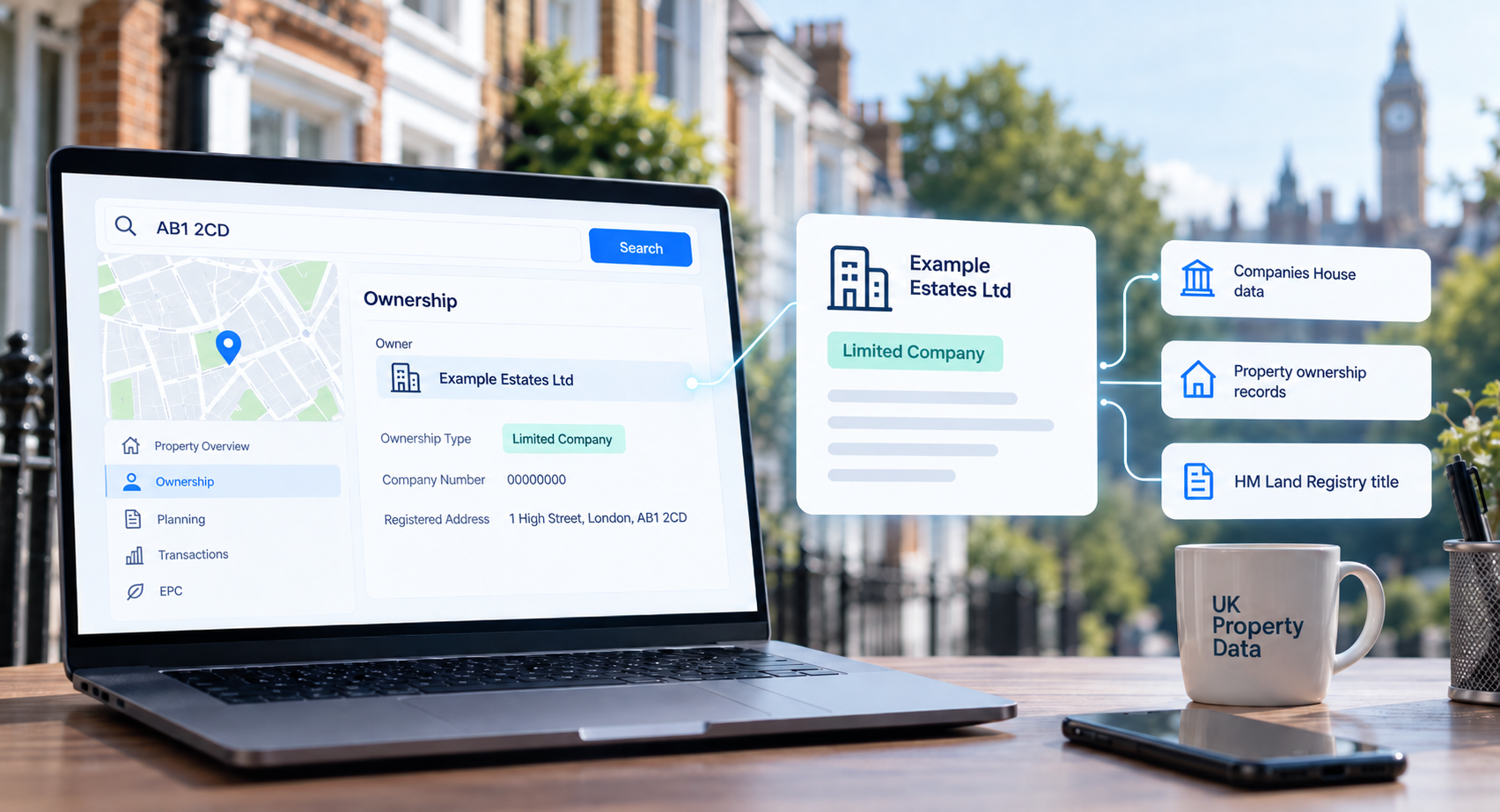
You look for the registered proprietor on the title. HM Land Registry's corporate ownership dataset, formerly published as Commercial and Corporate Ownership Data, lists titles in England and Wales where the registered legal owner is a non private individual, and carries the proprietor's name, company registration number and proprietorship category alongside the title number and property address.
The dataset is published monthly, from the second working day of the month, as a full file and a change only file. Records are removed where an excluded owner type is the sole owner, and the excluded types include private individuals, overseas companies, which are published separately, and charities.
That exclusion list is the first thing to internalise. A property held by an overseas company will not appear in this dataset at all, and its absence is not evidence that a company does not own it.
What does a registered company search actually establish?
It establishes that a named legal entity is recorded as the proprietor of a title, on the date the file was produced. That is a narrower claim than it sounds, and three qualifications come from HM Land Registry's own technical specification rather than from anyone's opinion of it:
- Currency. The dataset states that the information about owners may not always reflect the position on the Register. A monthly file is a snapshot, and a transfer completed after it was produced will not be in it.
- Completeness. The specification notes typographic errors in company registration numbers, and that approximately two per cent of LTD or PLC titles registered after a given date carry no company registration number at all.
- Dating. Approximately two per cent of titles have a blank date proprietor added field, so holding period cannot be calculated for all of them.
None of that makes the data unusable. It makes it evidence rather than proof, and the difference matters when the output is going in front of a lender, an insurer or a vendor.
A company search tells you who is on the title. It does not tell you who is behind the company, and it never claimed to.
Why should you search by company number rather than by name?
Because a company registration number is stable and a company name is not. Names get changed, re registered, and reused, and they differ from each other by a suffix that a matching routine will either ignore or treat as decisive.
| Searching by company name | Searching by company number | |
|---|---|---|
| Matches | Whatever string form the register holds | The registered entity |
| Common failure | Suffix and punctuation differences, and companies that have changed name since registration | Titles where no number was recorded, and numbers recorded with a typographic error |
| Best used | When the number is not known, as a first pass | Whenever the number is available |
| Verify against | Companies House, to confirm the entity behind the name | Companies House, to confirm the number resolves to the entity you meant |
Why do group structures break the trail?
Because a search matches the entity you name, and a group does not hold its property under one entity. Stock is commonly spread across several special purpose companies, sometimes one per site or per financing arrangement, each of which is a separate registered proprietor with its own number.
Searching the parent company in that structure returns whatever the parent holds directly, which may be nothing. The portfolio is real, and a single search will not show it. The practical answer is to work outward: establish the entity on the title first, then use Companies House to find the related entities, then search each one. That is slower than most people expect, and it is the actual job.
What can you not establish this way?
You cannot establish beneficial ownership. The register records the legal owner, and a company can be owned by other companies, by trusts, or by people who appear nowhere in the property record. Companies House holds information on people with significant control, which is a separate enquiry against a separate register.
You also cannot establish intent. A company holding nine properties on a street may be a long term investor, a developer part way through a scheme, or an estate being wound up. The record shows the holding. It does not show the plan, and reading one into the other is how a well researched approach becomes an embarrassing one.
What you can establish, and what makes the exercise worth doing, is concentration. One property under a company tells you almost nothing. Nine under the same registered proprietor across four postcodes tells you what kind of counterparty you are dealing with, whether you are lending, insuring, buying or working out who runs a street.
HM Land Registry publishes the registered corporate owners of titles in England and Wales monthly, with the proprietor name, company registration number and proprietorship category. Overseas companies are published separately and private individuals and charities are excluded, so an absence from the file proves nothing.
Search on the company registration number where you have it, expect group structures to spread a portfolio across several entities, and treat the result as evidence of the registered legal owner rather than of beneficial ownership. The Land Registry's own specification notes typographic errors in company numbers and that the file may not always reflect the position on the Register.
Ownership research is only as honest as the limits stated alongside it, and propalt.ai is built on the principle that those limits belong in the answer rather than in the small print.
Sources and data references
- HM Land Registry, GOV.UK. 'UK companies that own property in England and Wales.' Defines the dataset as registered titles where the registered legal owner is a non private individual. gov.uk/guidance/hm-land-registry-uk-companies-that-own-property-in-england-and-wales
- HM Land Registry. 'UK companies that own property in England and Wales: technical specification.' Source for the 29 fields, the monthly publication from the second working day, the excluded owner types, and the stated data quality caveats on company registration numbers and date proprietor added. use-land-property-data.service.gov.uk/datasets/ccod/tech-spec
- HM Land Registry. 'Overseas companies that own property in England and Wales: technical specification.' The separate dataset for overseas corporate owners. use-land-property-data.service.gov.uk/datasets/ocod/tech-spec
- Companies House, GOV.UK. Guidance on company registration numbers and people with significant control. The separate register for the question of who is behind the entity. gov.uk/government/organisations/companies-house
- Open Ownership. 'Registers of land ownership and restricted rights.' On the distinction between registered legal ownership and beneficial ownership. openownership.org
- HM Land Registry blog. 'Commercial and Corporate Ownership Data.' Background on the dataset's release and naming. hmlandregistry.blog.gov.uk