Every UK property data project starts the same way: with a free download.
A Friday afternoon, a five-gigabyte Price Paid file from HM Land Registry, a quick import script, and the feeling that this is going to be straightforward. Six weeks later the EPC endpoint has moved, the address matching has stalled at 80 per cent, and legal wants to know who cleared the Royal Mail licence on the address fields. The data was free. The pipeline is where the budget went.
None of that is an argument against open data, which is excellent and getting better. It is an argument for knowing the terrain before you build. This guide maps what is open in 2026, what changed this year, where the real difficulty sits, and how the Propalt AI API packages that difficulty behind one contract.
What UK property data is open in 2026?
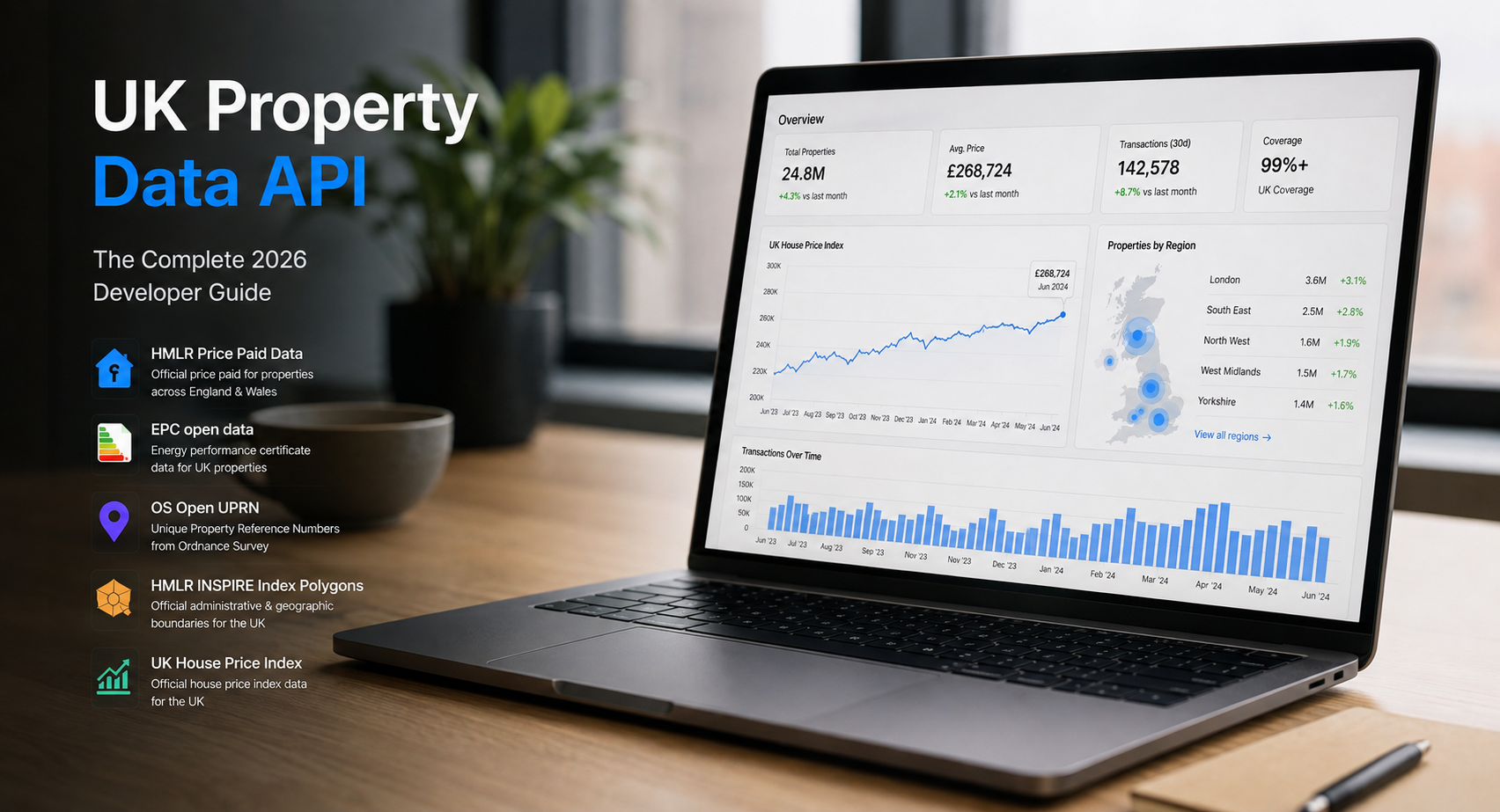
Five core datasets cover most use cases, all free at the point of download.
| Dataset | Coverage | Refresh | Licence |
| HMLR Price Paid Data | Residential sales, England and Wales, since January 1995; 24m+ records | Monthly, 20th working day | OGL v3.0; third-party rights in address fields |
| EPC open data | Certificates lodged in England and Wales since 1 October 2008; close to 30m | Regular; bulk file c. 5.6GB | Mixed: OGL plus Royal Mail address IP; sign-up required |
| OS Open UPRN | c. 40m unique property identifiers, Great Britain, with coordinates | Periodic OS Data Hub releases | OGL, royalty free since July 2020 |
| HMLR INSPIRE Index Polygons | Indicative extents of registered freeholds, England and Wales | Monthly | Free, with OS conditions on onward use |
| UK House Price Index | Monthly price index, HMLR and ONS | Monthly | OGL |
Scotland and Northern Ireland operate separate land registers and EPC systems. Coverage claims in this guide are England and Wales unless stated. Three practical details worth knowing before you build against these sources directly.
Price Paid Data lags reality: the gap between completion and registration typically runs from two weeks to two months, and monthly files carry addition, change and deletion markers, so an append-only pipeline drifts out of sync. Leases of seven years or less are never registered.
EPC data moved this year: epc.opendatacommunities.org was retired on 30 May 2026 and replaced by get-energy-performance-data.communities.gov.uk, so any integration guide written before mid-2026 is suspect on endpoints. Access requires an account because the records contain personal data.
Why is joining UK property datasets the hard part?
Because the join key and the address live in different places. The UPRN, the Unique Property Reference Number, is the canonical identifier: stable from planning permission to demolition, mandated as the public sector standard since 1 July 2020. But OS Open UPRN gives you the identifier and its coordinates, not the address; the UPRN-to-address link lives in AddressBase, a licensed Ordnance Survey product. And Price Paid Data carries no UPRN column at all, so matching sold prices to a property means string matching against inconsistent address formats.
The licensing compounds it. The Open Government Licence does not cover third-party rights, and address fields are where those rights concentrate: Price Paid addresses are processed against AddressBase Premium, which incorporates Royal Mail's PAF database, with defined permitted uses. Get this wrong and the compliance review happens after launch, at the worst possible price.
How does the Propalt AI API solve this?
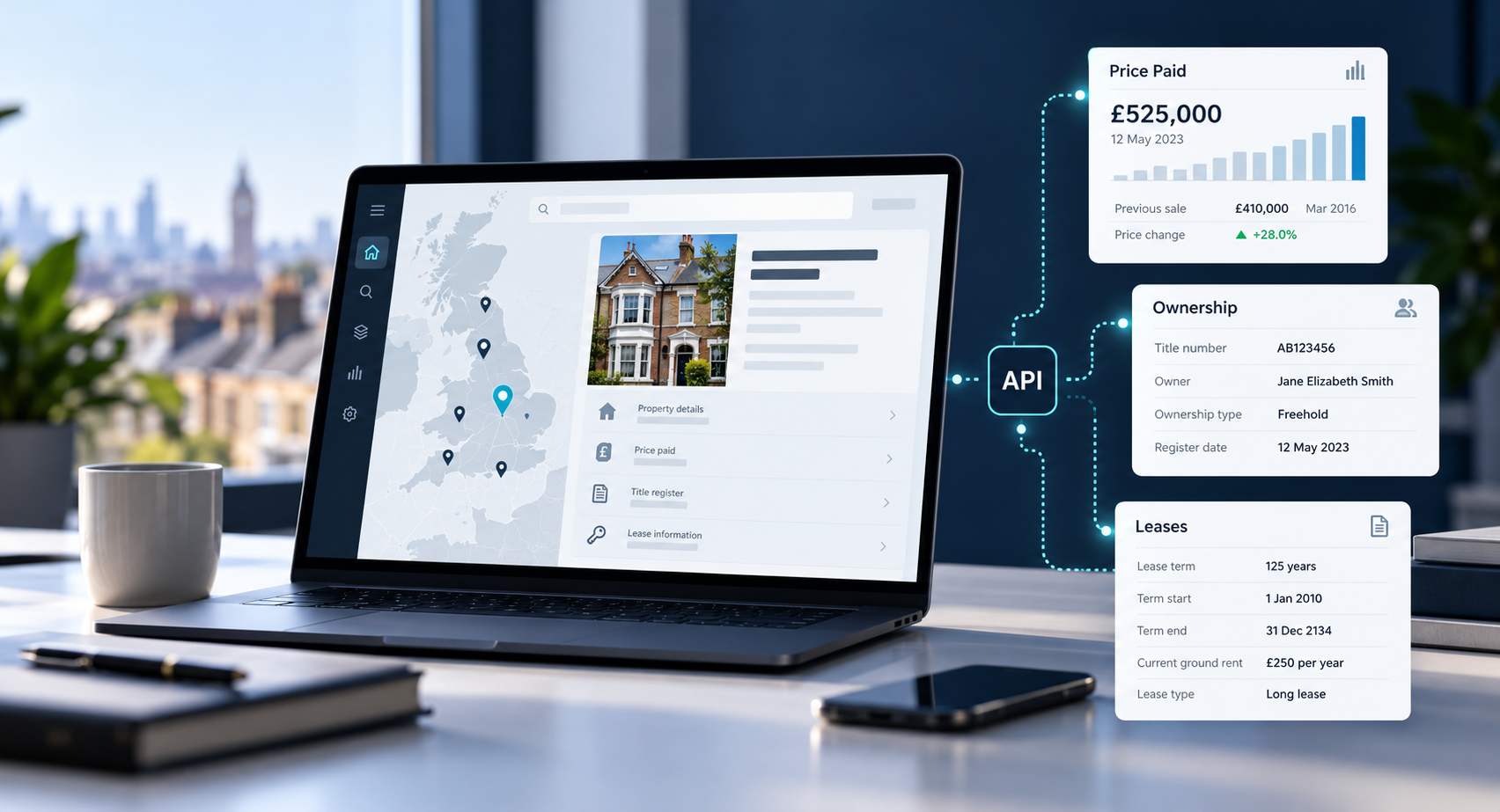
By packaging the joined, refreshed, licence-cleared layer behind one contract. The specifics: 29 million UK properties built on 8 authoritative registers, served across 150+ endpoints under a single OpenAPI 3.1 specification with typed SDKs for Node and Python. Records are UPRN-native, so Land Registry transactions, EPC fabric data, tenure, lease records, comparables and area market data resolve to the same property without string matching on your side. Data refreshes on a 24-hour cycle.
Pricing is credit-based with no platform fees: you pay for the calls you make, not for a seat licence. And there is no lock-in by design: your queries, your exports, your data. For a PropTech platform, that is one schema, one invoice and one integration in place of separate contracts with each upstream source.
The same data is reachable without writing integration code at all. Propalt AI ships MCP tools for Claude and ChatGPT, so a product team can prototype queries conversationally, in plain English against live data, before committing a line of code. For what that unlocks on the commercial side of the fence, see our companion piece on AI landlord prospecting for estate agents.
How do you evaluate any UK property data API?
Put four questions to any vendor, including us, before signing. Which underlying sources do you use, and under what licences? Is the UPRN native to every record? What is the stated refresh cadence per dataset? Can we export our data and leave? A vendor that answers all four in writing is selling infrastructure. One that will not is selling lock-in. Propalt AI's answers to all four are in the documentation, in writing.
How do you get started?
The free tier is a working property data API free tier, not a demo: 500 credits, no card required, and every endpoint open from day one. Start free, pull a property you know well, request its transaction history, EPC fabric data and comparables, and check the results against reality. If the data holds up on a property you can verify, it will hold up on the ones you cannot.
📌 KEY TAKEAWAY
In 2026 the core UK property datasets are open, and the cost sits in the joins, the refresh cycle and the licence boundaries around address data. The Propalt AI API packages that layer behind one OpenAPI 3.1 contract: 29 million UK properties, 150+ endpoints, UPRN-native records, 24-hour refresh, typed SDKs for Node and Python, MCP tools for Claude and ChatGPT, and credit-based pricing with no platform fees or lock-in. Start free at propalt.ai: 500 credits, no card, all endpoints open from day one.
Sources
—HM Land Registry (updated monthly, 2026): Price Paid Data downloads —HM Land Registry (updated 2026): About the Price Paid Data —HM Land Registry Open Data portal: 24 million+ definitive records from January 1995 —MHCLG: Get energy performance of buildings data —EPC Works (2026): Obtaining EPC Data —MHCLG Digital (January 2024): Changes to the Energy Performance Certificates open data service —Ordnance Survey (2026): OS Open UPRN —GOV.UK (updated January 2026): Identifying property and street information