Most UK property data APIs demo well. The problems surface in month three, when a data type you assumed was included turns out to sit behind a higher tier, the headline price bears no relation to your real call volume, or you try to get your own data back out and cannot.
Choose a UK property data API on six criteria: coverage on the tier you would actually buy, refresh cadence matched to the decision each data type drives, true cost per useful call once credit weights are applied, delivery model (REST, MCP or both), source and licence transparency, and data ownership with a clean exit. Price the real workflow, then read the terms. The feature list is the least useful page on any vendor site.
This guide is a framework, not a ranking. Work through the six criteria against your own use case, then put the vendor questions at the end to everyone on your shortlist. If you want providers compared side by side, see the companion piece, Best UK Property Data APIs in 2026, Compared.
Disclosure: Propalt AI is a UK property data API and appears in this guide. The six criteria are written to be applied to any provider, including ours. Where we are named, it is as one option among several, and the worked cost model below includes a workflow where a competitor comes out cheaper than we do.
What is a UK property data API?
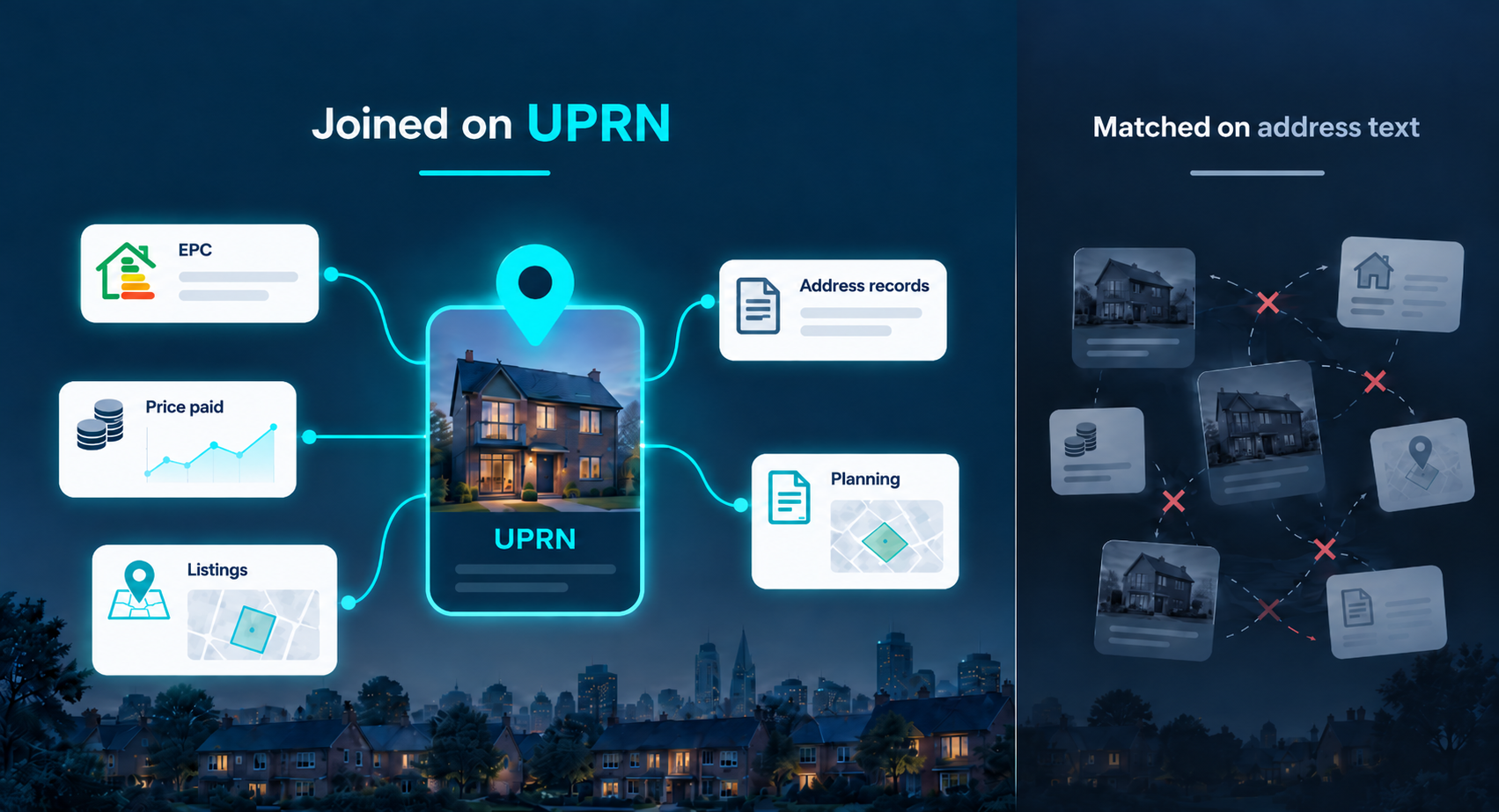
A UK property data API is an aggregation layer that returns structured property data as JSON, matched to a unique property identifier such as a UPRN. The underlying records are largely public: HM Land Registry Price Paid for sold prices, the MHCLG register for EPC, Ordnance Survey for UPRN, the Environment Agency for flood risk, the Valuation Office Agency for council tax bands. What you pay for is the matching, cleaning, refresh and delivery, not the raw data itself. That distinction matters, because it is what you should be judging providers on.
Start with the job, not the feature list
Write down the exact data types your product needs and the decision each one drives. "EPC rating for a valuation flow" is a usable requirement. "Property data" is not.
This one list prevents most bad purchases, because it turns a vague sense of coverage into a checklist you can hold each provider against, tier by tier. Separate must-haves from nice-to-haves. A provider that covers your three must-haves at a fair price beats one that covers forty data types you will never call.
The six criteria that decide fit
Score every shortlisted provider against all six. Most buyers score the first two and skip the last, which is why the last one is the one they regret.
| Criterion | What to check | Failure mode if you skip it |
|---|---|---|
| Coverage at your tier | Each must-have data type is on the plan you are pricing, and your geography is covered | Month three: the data type you built around needs an upgrade |
| Freshness | Refresh cadence per data type, matched to the decision it drives | Stale listings in a live workflow, or paying real-time rates for monthly data |
| True cost per call | Credit weights and per-lookup charges modelled against your real monthly volume | A bill two to five times the headline estimate |
| Delivery model | REST, MCP, or both, plus an OpenAPI spec | A rebuild when you add an AI agent to the product |
| Source and licence | Named source and licence behind each endpoint | Redistribution rights you do not have, and no audit trail |
| Ownership and exit | Full export in CSV or Parquet, month-to-month terms | Switching cost that outweighs any price saving |
Does the tier you would actually buy include your data types?
Providers advertise total coverage, but data types are often split across tiers or sold as separate products. Confirm every must-have sits on the plan whose price you are quoting yourself, in writing.
Check geography with the same care. Coverage outside England and Wales is patchy across this whole market. Scotland runs on Registers of Scotland rather than HM Land Registry, and Northern Ireland on Land and Property Services, so "UK coverage" is a claim worth testing against a postcode you actually operate in, on the specific data types you need rather than on the marketing page.
How fresh does each data type need to be?
Match refresh cadence to the decision, not to the marketing. Listing-driven workflows covering new instructions, price changes and availability need daily data or better. Sold prices follow the Land Registry release cycle, and EPC and planning update on their own government cycles.
Ask for cadence per data type rather than a single number for the platform. A provider may refresh listings daily and Ordnance Survey references quarterly, and both answers can be correct at once. Paying for real time where a monthly cycle would do is wasted spend. The reverse is a data quality risk you will find out about from a customer.
What does one full property record really cost?
The headline price is rarely the real one. Some providers weight calls or credits, so a single high-compute endpoint such as comparables, valuations or listings costs several units. Others charge per lookup, so a find then retrieve pattern costs multiple units per property. A third group charges per property and returns everything at once.
Model your expected monthly volume against the actual weights, then compare. That number, not the plan price, is what you are buying. Here is what it looks like worked through.
Worked example: one property record across three providers
Two workflows, both at 10,000 records a month. The credit weights, plan prices and overage rates used below were captured from each provider's own public pricing pages on 1 August 2026, and we recheck them quarterly.
Workflow A, attribute enrichment: address match, full property record, EPC and building fabric, planning or environmental risk.
Workflow B, valuation flow: the same four calls plus comparables.
| Propalt AI | Homedata | Street Data | |
|---|---|---|---|
| Units per record, workflow A | 5 credits (1 + 1 + 2 + 1) | 9 calls (2 + 5 + 1 + 1) | 1 lookup |
| Monthly units, A | 50,000 | 90,000 | 10,000 |
| Cheapest published route | Startup £199 (25,000 credits) plus 25,000 overage at £0.005 = £324 | Pro £349 covers 50,000, so Scale = £699 | Core tier at £0.10 = £1,000 |
| Cost per record, A | 3.2p | 7.0p | 10.0p |
| Units per record, workflow B | 17 credits (A plus 12 for comparables) | 19 calls (A plus 10 for comparables) | 1 lookup |
| Monthly units, B | 170,000 | 190,000 | 10,000 |
| Cheapest published route | Agency £499 (100,000 credits) plus 70,000 overage at £0.005 = £849 | Scale = £699 | Premium tier at £0.50 = £5,000 |
| Cost per record, B | 8.5p | 7.0p | 50.0p |
Three things this exercise shows, and none of them are visible on a pricing page.
The headline price is not the ranking. All three providers look comparable at the top of their pricing pages. At 10,000 records a month the spread on the same workflow is more than fifteen fold.
Weighting structure beats unit price. Propalt is cheaper on workflow A because its address and property calls cost 1 credit each where a find then retrieve pattern costs 7. Homedata is cheaper on workflow B because its comparables endpoint is weighted at 10 calls against our 12 credits, and its £699 tier has enough headroom to absorb it. Neither provider is cheaper in general. Your endpoint mix decides it.
Tier steps matter as much as rates. Workflow A on Homedata needs 90,000 calls, which means buying the 250,000 call plan and leaving 160,000 unused. Providers that bill overage against a lower tier, as Propalt does at £0.005 per credit, cost less at awkward volumes. Providers with per-property pricing, like Street Data, have no tier problem at all, which is why the £50 signup credit makes them the cheapest way to test a few hundred records. The crossover is around 500 records a month.
Run the same table with your own endpoint sequence before you sign anything. If a provider cannot give you per-endpoint weights, you cannot do this exercise, and that is itself an answer.
REST, MCP, or both: which fits how you build?
A REST JSON API suits classic integrations and is the right default for most product work. If you are building with AI agents or copilots, an MCP server lets tools such as Claude, ChatGPT and Cursor call the data directly, and an OpenAPI spec plus Markdown output makes that cleaner still.
Ask whether MCP is on your tier or only on paid plans, because that varies by provider. And treat a SaaS dashboard as a different product. Useful for research, not for powering software. Do not let a dashboard trial stand in for an API evaluation.
Which sources sit behind each endpoint, and under what licence?
Because much of the underlying data is public, ask which sources sit behind each endpoint and on what licence terms. Some data carries its own licensing cost that flows through to your price, Royal Mail PAF address data being the common one. Ask about redistribution too, because the terms that cover your internal use may not cover surfacing the same data to your own customers.
A provider that names its sources openly is easier to audit, and much easier to defend when a customer asks where a number came from.
Can you export your data and leave without penalty?
This is the criterion buyers skip and later regret. Can you export everything you have pulled, in a machine-readable format such as CSV or Parquet, at any time? Can you switch provider without a penalty or a long lock-in?
Ask the question at tier level, not platform level. Export gated to a higher plan than the one you are buying is not export you have. Month-to-month billing and a clean export path are what separate a partner from a trap. Get both in writing before you sign, because neither is negotiable once you are integrated.
The six types of UK property data provider
UK providers fall into a handful of shapes, and the shape tells you most of what you need. Buying across shapes, taking an analytics tool when you needed an attribute API, is the most common and most expensive mismatch in this category.
| Shape | What it is | Right for | Examples |
|---|---|---|---|
| Multi-attribute property APIs | Broad coverage across property attributes, prices, risk, EPC and planning from one integration | Products needing several data types per property, replacing multiple data contracts with one | Propalt AI, Homedata |
| Listing and enrichment feeds | Built around live market activity and per-property enrichment | Agent-facing and portal workflows | Street Data |
| Investment analytics APIs | Centred on yields, growth and area level market metrics | Investor and lettings tooling | PropertyData |
| Address and postcode APIs | One job, done well: address lookup and validation | Checkout, onboarding and form validation | Ideal Postcodes |
| Land and planning platforms | Map-first SaaS for site research and land sourcing | Developers and surveyors, as a dashboard rather than a feed | Searchland |
| Report products | Client-ready, white-labelled property reports, with API access secondary | Estate agents and conveyancers presenting to clients | Sprift |
Questions to put to any vendor
Get answers to these in writing, from every provider on the shortlist, before you commit.
- Which of my specific data types are on the tier I am quoting, and which need a higher tier or a separate product?
- What is the credit or call weight of each endpoint I will use, and what does one full property record cost at my expected monthly volume?
- What happens when I exceed my allowance: overage billing, a hard cap, or a forced upgrade?
- How fresh is each data type, and what is the underlying source and licence?
- Do you offer REST, MCP, or both, is MCP on my tier, and is there an OpenAPI spec?
- Can I export all my data in a usable format, on the tier I am buying, and switch away without penalty?
- What is the geographic coverage, specifically for Scotland and Northern Ireland if I operate there, by data type?
- What are your redistribution rights, if my product surfaces this data to my own customers?
- What rate limit, uptime commitment and support response time apply on my tier?
Choosing a UK property data API is less about the feature list than about pricing the real workflow and reading the terms. Define your must-have data types, then score each provider on coverage at your tier, freshness, true cost per call, delivery model, source licensing, and data ownership. Model the cost of one full property record on published weights, not the headline plan price, and get the exit terms in writing.
Frequently asked questions
How do I choose a UK property data API?
Start from the exact data types your product needs and the decision each one drives. Then score each provider on six criteria: coverage on the tier you would actually buy, refresh cadence per data type, true cost per useful call once credit weights are applied, delivery model, source transparency and licensing, and data ownership and exit terms. Test the shortlist against a free tier rather than a sales deck.
What should a UK property data API cost?
It depends on volume and pricing model. UK providers range from pay as you go per lookup to monthly subscriptions and seat-based SaaS. Model your expected call volume against each provider's credit weights, because a single enrichment workflow can consume several credits per property. In the worked example above, the same four-call enrichment workflow at 10,000 records a month came to 3.2p, 7.0p and 10.0p per record across three providers. The headline plan price is rarely the cost you pay.
REST or MCP: which do I need?
Use REST for classic software integrations, where your own code calls the API. Choose a provider with MCP access if you are building with AI agents or copilots, so tools such as Claude and ChatGPT can call the data directly. Several UK providers now offer both, which avoids a rebuild when you add an agent later. Check whether MCP is included on your tier or gated to paid plans.
Why does data ownership matter when choosing a property data API?
Because switching cost is a real cost. If you cannot export your data in a usable format, or you are locked into a long contract, you are tied to the provider regardless of how the product evolves or how their pricing changes. Confirm export format, the tier export sits on, and exit terms before you sign, not at renewal.
Do UK property data APIs cover Scotland and Northern Ireland?
Coverage outside England and Wales is thin across the market. Sold price data for England and Wales comes from HM Land Registry, while Scotland is served by Registers of Scotland and Northern Ireland by Land and Property Services, each licensing separately. Some providers publish partial Scottish coverage on selected data types, and several cover England and Wales only. Test a postcode in every region you operate in, on the data types you actually need, during the trial.
What data does Propalt AI include, and what does it cost?
Propalt AI exposes 36 endpoints across 11 categories, returning more than 150 property attributes: valuations, ownership and tenure, listings and listing history, rental data, landlord and portfolio tracking, EPC and building fabric, environmental risk, planning, comparables and market analytics across 29 million England and Wales addresses, with partial Scottish coverage on sold prices, EPC, planning and the sales pipeline. It is built on 8 official UK registers plus Propalt's own market datasets, refreshed daily on Land Registry, Companies House, listings, sales and rentals, and on each register's own cycle for the rest. Delivery is REST plus an MCP server on every plan including the free tier, with an OpenAPI 3.1 spec and Markdown output. The free tier is 500 credits a month with no card; paid plans run from £49 a month for 5,000 credits to £2,999 for 750,000, month to month with no contract, with bulk CSV and Parquet export from the £499 Agency tier upward.
Put the framework to work
The best way to test these six criteria is to run them against a live API rather than a sales page. Point your real must-have data types at a free tier, model the cost of one full record on the published weights, and score each criterion yourself, from coverage on your tier to the export terms in the contract.
Propalt AI publishes its data sources, per-endpoint credit weights, rate limits and export terms, and offers a free tier with no card, so you can score all six criteria in an afternoon. Start free at propalt.ai.
Sources and data references
Provider pricing and weights checked on 24 August 2026 against each provider's own published pages. Competitor links are nofollow.
- HM Land Registry. Price Paid Data, the open source underlying sold price data. gov.uk/government/collections/price-paid-data
- MHCLG. Energy Performance of Buildings Register, open EPC data. epc.opendatacommunities.org
- Ordnance Survey. OS Open UPRN and identifiers. ordnancesurvey.co.uk/products/os-open-uprn
- Environment Agency. Long-term flood risk data. gov.uk/check-long-term-flood-risk
- Registers of Scotland and Land and Property Services. House price and title data for Scotland and Northern Ireland.
- Propalt AI (August 2026). Pricing, per-endpoint credit weights, overage rate, export terms and data sources. propalt.ai/pricing and propalt.ai/product/dataSources
- Homedata (August 2026). API pricing and published call weights. homedata.co.uk/pricing
- Street Data (August 2026). Per-property pricing tiers and data point coverage. data.street.co.uk/pricing