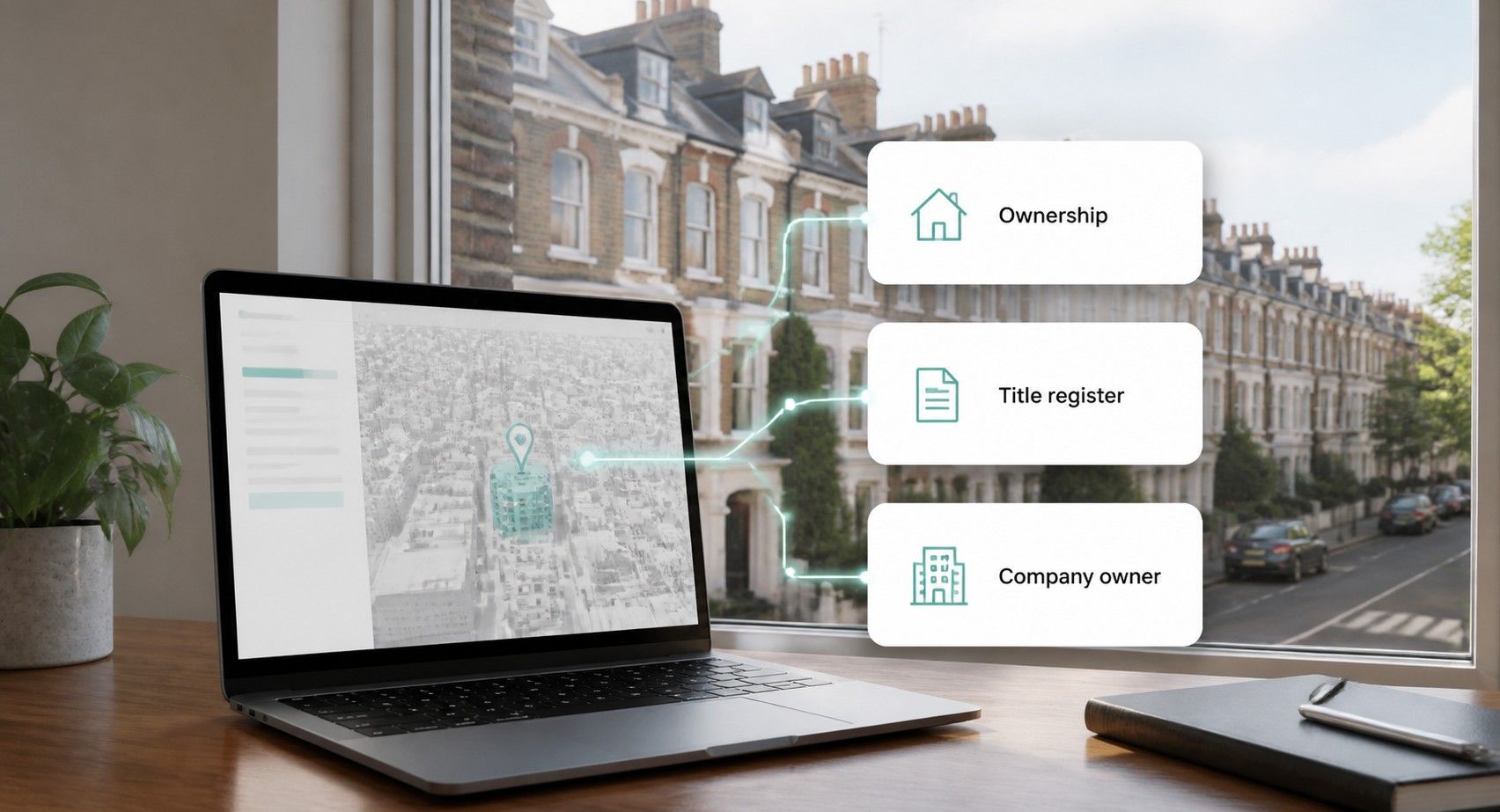
In England and Wales, you can find out who owns a property for £7. HM Land Registry (HMLR) sells a downloadable copy of the title register through GOV.UK, and the register names the legal owner. More than 90% of the land area of England and Wales is now registered, across more than 27 million titles, according to HMLR's 2025 to 2026 annual report.
The harder cases are the other 10% or so: land that has never been registered, homes held through companies or offshore entities, and property in Scotland or Northern Ireland, which run separate registers.
This guide covers each route in turn, starting with the one most people need. Which record answers your question, and what does it cost?
How do I find out who owns a property in England or Wales?
Search the address on GOV.UK's "Search for land and property information" service, then buy the title register. As of October 2026, HMLR lists three levels of information:
| DOCUMENT | COST | WHAT IT SHOWS |
|---|---|---|
| Property summary | Free | Address, description, tenure (freehold or leasehold), whether covenants or easements exist |
| Title register | £7 download | Title number, owner, last sale price, whether there is a mortgage, details of covenants and easements |
| Title plan | £7 download | Location and general boundaries of the title |
| Copy for legal use (form OC1) | £11 by post, £7 via the portal | The version accepted as evidence, for example in court |
You need a debit or credit card and a sign-in. You can search by postcode, by street and town, by title number, or by map for land without a clear address.
Two cautions. The downloaded register cannot be used as proof of ownership; HMLR says you need the OC1 copy for that. And the register shows the legal owner. It does not show who funds the property, who lives there or who benefits from a trust.
If you already hold the property's UPRN, you can check tenure before you buy anything. In the Propalt API, a property lookup by UPRN returns tenure and the HM Land Registry title numbers linked to it, so you know which register to download. Our explainer What Is a UPRN? covers how the identifier works.
A title register names the legal owner on the date you download it. It does not tell you who controls that owner.
What does a title plan show, and when do I need it?
Buy the title plan when the question is about land rather than an address. It shows the location and general boundaries of the title, so you can see whether a garden strip, verge or access track sits inside a neighbour's title.
HMLR describes these as general boundaries. The plan shows roughly where the land lies; it does not fix the exact line between two properties. Boundary disputes usually need a surveyor and the title deeds as well as the plan.
Is there a free land registry map?
Partly. Two map routes exist, and they serve different users.
- MapSearch. A free HMLR service for Business e-services customers, mainly conveyancers and other professionals. It shows whether land is registered, its title number and its tenure. You need an HMLR portal account, and it gives no indemnity.
- INSPIRE Index Polygons. Free monthly downloads, under the Open Government Licence, showing the indicative extent of freehold registered titles. Each polygon carries an INSPIRE ID that you can use to look up the title in HMLR's Find a Property service. You need GIS software to open the files, and HMLR states that the polygons do not define title extent.
For a one-off "who owns this land" question, most people do not need either. The map option in the public search service will find the title, and the £7 register will name the owner.
If you need certainty about whether a parcel is registered at all, the search of the index map (SIM) costs £8 for up to five titles, as of October 2026.
How do I find out who owns land that is not registered?
Start by confirming it really is unregistered. An online search that finds nothing is not proof, especially for narrow strips; a SIM is the reliable check. HMLR's own guidance says that for unregistered land "we will not know who the owners are".
HMLR's blog on searching for unregistered owners suggests working outwards from the land:
- Ask locally. Neighbours, adjoining landowners, long-standing residents and local businesses often know.
- Read the neighbouring titles. Adjoining registers sometimes refer to "other land" sold off earlier and name the parties.
- Check the archives. County record offices, local libraries and the National Archives hold old deeds. Yorkshire and Middlesex had their own deeds registries.
- Check planning history. Planning applications in England and Wales must include an ownership certificate, and applicants who do not own all the land must notify the owners. Past applications on or next to the parcel can name them.
Planning history is the step that scales best. Our planning data API guide explains what each planning source holds.
HMLR notes that much Crown, Church and aristocratic land was never sold, and so was never registered. If you are thinking about using land you cannot trace, take legal advice first. Possession claims are complex, and HMLR staff cannot advise on legal rights.
Developers tracing several owners across one site will meet the same problem at larger scale. Our guide to land assembly covers how to approach it.
How does it work in Scotland and Northern Ireland?
Each has its own register, fees and search route.
Scotland. Registers of Scotland (RoS) runs the Land Register. Search ScotLIS, and order the title sheet to confirm the owner; RoS lists the title sheet and plan at £3 plus VAT. Older property still on the General Register of Sasines is harder to search, and RoS points users to its Property Help Service.
Northern Ireland. Land & Property Services (LPS) keeps the Land Registry. As of October 2026, nidirect says a public online search is not available, so you request it by email, phone or appointment. If the land is registered, the folio names the owner; inspection is £5 and an uncertified copy is £7. Unregistered land sits in the Registry of Deeds instead.
How do I find out if a company or overseas entity owns a property?
Read the proprietor on the title register first. If it is a company, two free HMLR datasets, both updated monthly, let you search at scale:
- UK companies (CCOD). Registered titles in England and Wales owned by UK companies and corporate bodies, with title number, tenure, address, price paid where recorded, proprietor name and company registration number.
- Overseas companies (OCOD). The same for non-UK companies, plus the country of incorporation.
Both need an account and acceptance of the HMLR data licence. Neither includes private individuals or charities, so a missing record does not mean no company is involved. Our guide to checking whether a property is owned by a limited company covers name versus number searches, group structures and the gaps in this data.
For offshore owners, add a second source. Since 1 August 2022, overseas entities that own UK land have had to register at Companies House and name their registrable beneficial owners. In England and Wales the rule reaches back to property bought on or after 1 January 1999, and entities must update the register every year. Most of the information is public, so an offshore company on a title can usually be linked to named beneficial owners or managing officers.
To search HMLR records by owner name rather than address, form PN1 costs £15 per name by post. It works for companies only; you cannot search for a private individual.
How do professionals run a property owner search at scale?
Title-by-title purchases work for a single site. They break down when a lender, developer or investor needs ownership across hundreds of addresses.
At that point the work becomes data engineering: loading CCOD and OCOD each month, matching addresses to UPRNs, linking titles to properties when one title covers several homes, and normalising company names before joining Companies House. Our guide to HM Land Registry data and APIs explains which HMLR datasets have an API, which are downloads only and what each licence allows.
📌 KEY TAKEAWAY
For a single home in England or Wales, the £7 title register answers who owns it, and the free property summary tells you whether there is a register to buy. Land needs the title plan or a search of the index map; unregistered land needs local detective work; Scotland and Northern Ireland have their own registers. Company and overseas owners sit in HMLR's monthly CCOD and OCOD files and on the Register of Overseas Entities. When the question covers many properties, the work moves from buying documents to joining datasets by UPRN, and the Propalt API returns title numbers and tenure for each UPRN, alongside company and landlord ownership data, through REST or through its MCP server in Claude and ChatGPT.
SOURCES & DATA REFERENCES
- GOV.UK / HM Land Registry (accessed October 2026). 'Search for land and property information.' Property summary free, title register and title plan £7, downloads not proof of ownership. gov.uk/search-property-information-land-registry
- HM Land Registry (2024, still applying October 2026). 'HM Land Registry: Information Services fees.' OC1 fees, SIM £8 for up to five titles, PN1 £15 per name, Land Registration Fee Order 2024 from 9 December 2024. gov.uk/guidance/hm-land-registry-information-services-fees
- HM Land Registry (2026). 'Annual Report and Accounts 2025 to 2026.' More than 27 million titles covering more than 90% of the land area of England and Wales. gov.uk/government/publications/hm-land-registry-annual-report-and-accounts-2025-to-2026
- HM Land Registry (accessed October 2026). 'Finding information held by HM Land Registry.' Search options, unregistered land returns no owner, company datasets, PN1 not available for individuals. gov.uk/guidance/finding-information-held-by-hm-land-registry
- GOV.UK (accessed October 2026). 'MapSearch.' Free for Business e-services customers; registration status, title number, tenure; no indemnity. gov.uk/mapsearch
- HM Land Registry (accessed October 2026). 'INSPIRE Index Polygons.' Freehold only, monthly, OGL, does not define title extent, look up via Find a Property. use-land-property-data.service.gov.uk/datasets/inspire
- HM Land Registry Blog (5 February 2018). 'Searching for the owner of unregistered land.' Local enquiries, adjoining titles, archives, planning certificates. hmlandregistry.blog.gov.uk/2018/02/05/search-owner-unregistered-land
- HM Land Registry (accessed October 2026). 'UK companies that own property in England and Wales' and 'Overseas companies that own property in England and Wales.' CCOD and OCOD contents, fields, monthly updates, exclusions, licence. use-land-property-data.service.gov.uk/datasets/ccod and /datasets/ocod
- Companies House (accessed October 2026). 'Register an overseas entity and tell us about its beneficial owners.' In force 1 August 2022, retrospective to 1 January 1999 in England and Wales, annual update statement, public information. gov.uk/guidance/register-an-overseas-entity
- Registers of Scotland (accessed October 2026). 'Search and order land and property deeds.' ScotLIS, title sheet £3 plus VAT, Sasine Register. ros.gov.uk/services/order-deeds
- nidirect (accessed October 2026). 'Searching the Land Registry.' No online public search at present, folio contents, fees, Registry of Deeds. nidirect.gov.uk/articles/searching-the-land-registry