As of October 2026, EPC data for England and Wales is published through a GOV.UK beta service called Get energy performance of buildings data. It offers bulk CSV downloads and a developer API for domestic EPCs, non-domestic EPCs and Display Energy Certificates, with certificates registered since 2008.
The old Open Data Communities EPC site now redirects there. If your code still calls epc.opendatacommunities.org, check it this week.
Scotland runs a separate register on different terms. So what does the EPC register hold, where can you get it, and what goes wrong when you join it to property records?
What is in the EPC register?
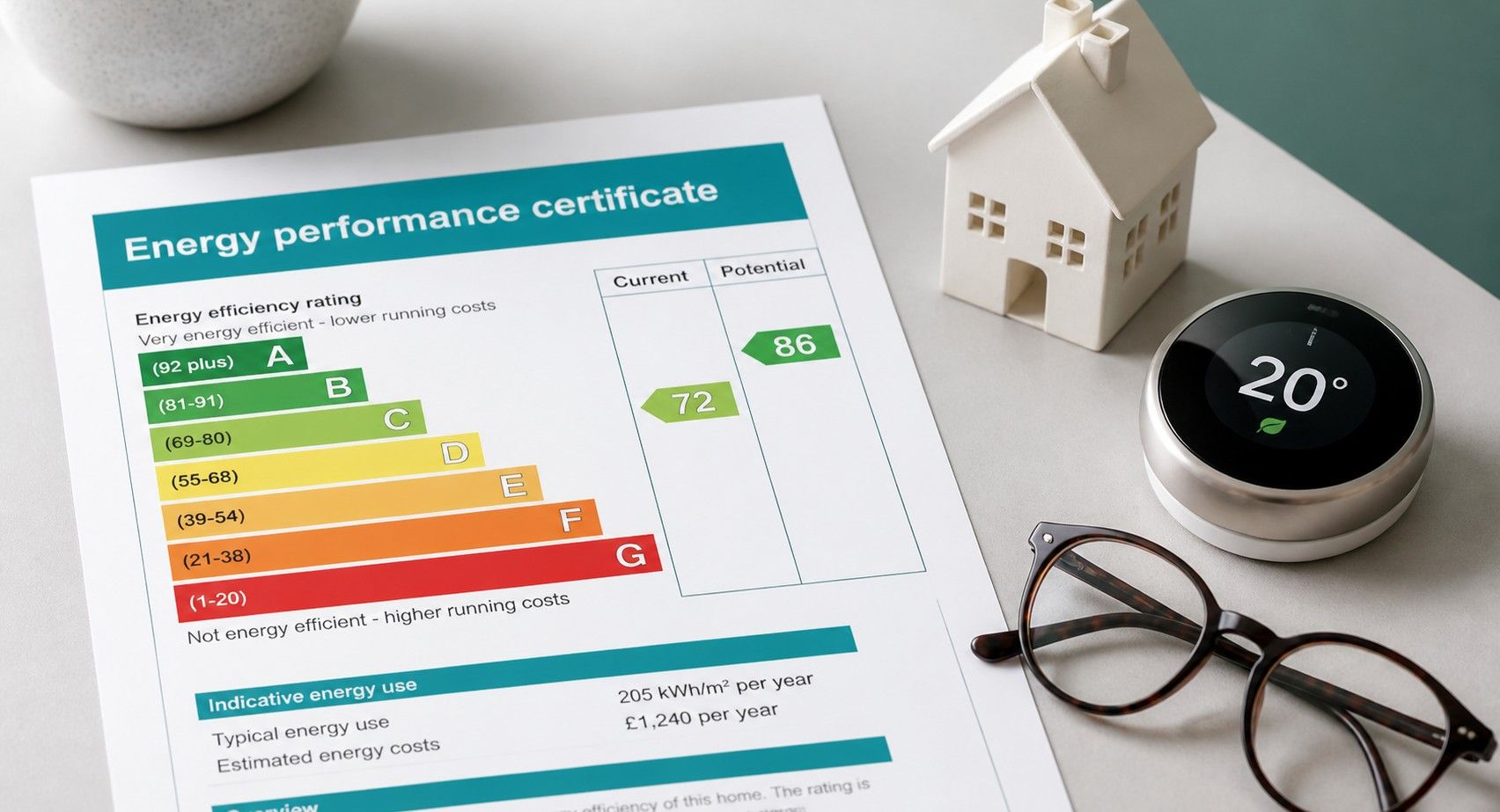
Each EPC is a record of one energy assessment, lodged on the register by an accredited assessor. The table below lists the main fields Propalt receives in each domestic EPC record, grouped by what they tell you. For how the EPC register sits alongside title, sales and address data, see our guide to UK property data sources.
| Group | Example fields |
|---|---|
| Certificate | Certificate key (LMK key), inspection date, lodgement date, transaction type (for example marketed sale) |
| Address | Address lines, postcode, local authority, constituency |
| Ratings | Current and potential energy rating (A to G), current and potential efficiency score, environmental impact score |
| Size and form | Total floor area, number of habitable and heated rooms, floor height, construction age band, extension count |
| Fabric | Walls, roof, floor and windows descriptions, each with an energy efficiency rating from Very Poor to Very Good |
| Heating | Main heating description and controls, main fuel, mains gas flag, hot water system, secondary heating |
| Running costs | Current and potential lighting, heating and hot water costs |
| Emissions and energy | CO2 emissions current and potential, CO2 per square metre, energy consumption |
| Renewables | Photovoltaic supply, solar water heating flag, wind turbine count |
Source: Propalt (October 2026), fields returned by Propalt's EPC fabric data.
One detail matters for anyone building on it. Many fabric descriptions carry the word "assumed", as in "Solid brick, as built, no insulation (assumed)". The assessor could not see the construction, so the value is a default.
Where can you get EPC open data in England and Wales?
The GOV.UK Get energy performance of buildings data service is the official route for bulk EPC open data and the EPC API in England and Wales. It describes itself as a service for "researchers and product developers" and offers two options:
- Bulk download. Certificate data in CSV format. You need to sign in or create an account with GOV.UK One Login.
- Developer API. Programmatic access to certificate data for applications.
For a single property, the public Find an energy certificate service on GOV.UK lets anyone search by postcode, street and town, or certificate number.
Licensing needs care. The new service states that site content is available under the Open Government Licence v3.0 "except where otherwise stated", so read its terms for address-level data before you build them into a product.
The register has also carried an opt-out since 2019. MHCLG resumed publication that year under a revised privacy notice that lets property owners opt out, so a missing certificate in the open data does not always mean no EPC exists.
A missing EPC in the open data can mean no certificate, an opted-out certificate, or a certificate your matching failed to find. Treat the three differently.
How does Scotland differ from England and Wales?
Scotland's EPCs sit on the Scottish EPC Register, which the Energy Saving Trust operates. You can retrieve a certificate by report reference number or postcode, and the register "will only allow you to view the current valid document for a building".
The Scottish register prohibits "the use of any automated software program to access the register or website". For product teams, the practical position is that an England and Wales EPC pipeline does not carry over to Scotland unchanged.
The 2030 minimum energy standard for private rented homes discussed below also applies to England and Wales only.
What data quality issues should you plan for?
EPC data carries building fabric detail you will not find in sales or title records, and it still needs cleaning before you rely on it.
- Old and replaced certificates. The service warns that the data "includes certificates registered since 2008, which may have expired or been replaced". A house can have several certificates. Pick the latest by lodgement date, and decide whether an expired one is still useful evidence.
- Partial coverage. The data.gov.uk record notes that the registers do not cover every building and "should, therefore, not be interpreted as a true representation of the whole of the building stock". Homes that have not been sold or let since 2008 may have no EPC.
- Anomalies. The same record warns that anomalies may exist in the published data. Validate floor area, room counts and property type against other sources before using them in a model.
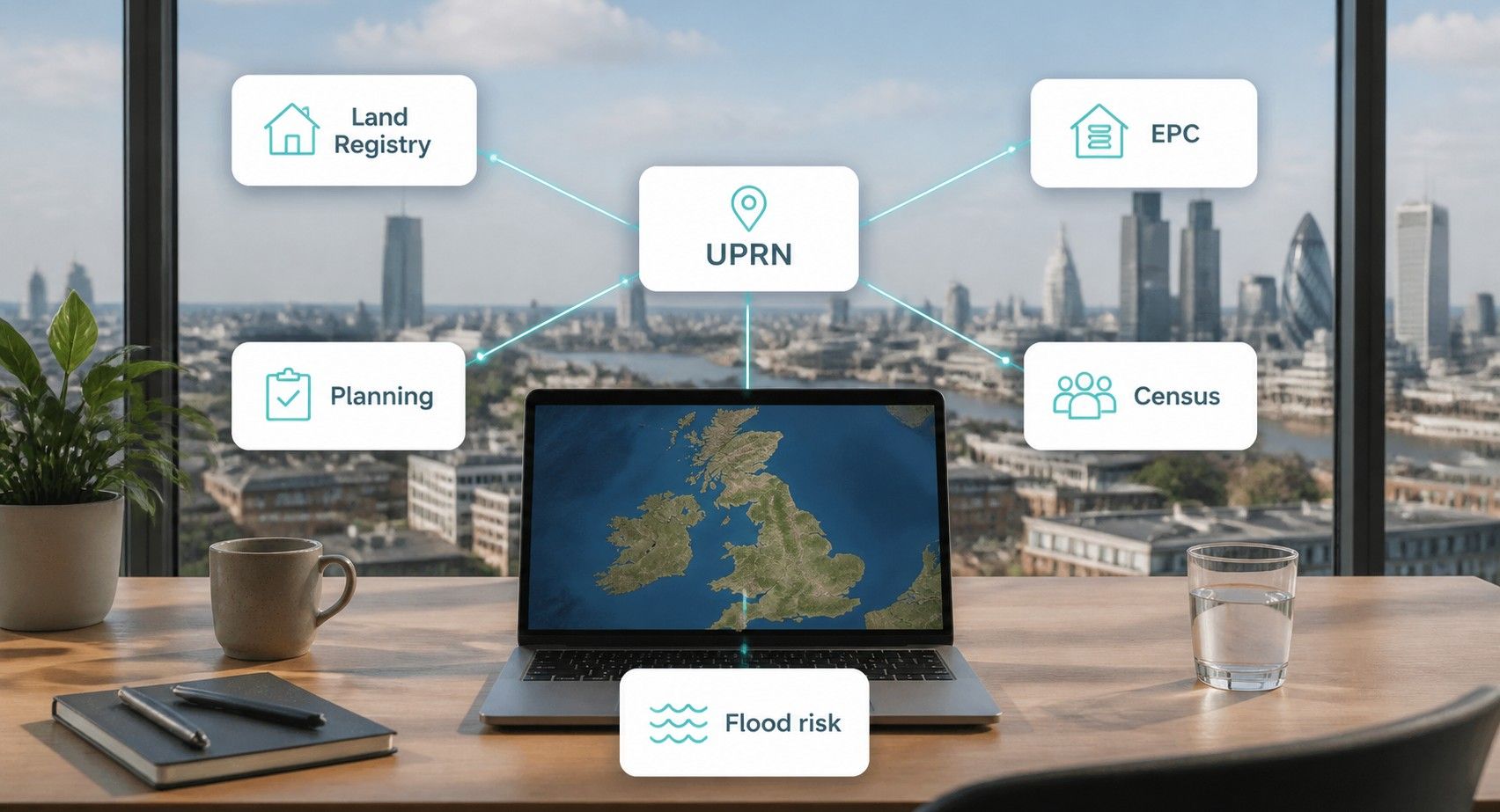
- Address matching. EPC addresses are typed by assessors, so "Flat 2, 10 High Street" and "10b High Street" can be the same home. Joining EPCs to sales, titles or valuations by address text alone produces false matches and misses. Matching to a UPRN is the reliable join. Check how your provider does that match and what share of records it resolves.
- Assumed values. Fabric fields marked "assumed" are defaults, not observations. A retrofit model that treats them as fact will overstate the work needed on some homes and understate it on others.
Who uses EPC data, and for what?
Three groups use the EPC database for distinct jobs.
- Retrofit and energy businesses. Fabric fields let installers find homes with uninsulated solid walls, no roof insulation or old heating systems in a given area, then plan work by street. In LS6 in Leeds, Propalt's energy search returns 6,683 houses whose EPC records walls with no insulation (October 2026), though some of those wall values will be assumed rather than observed. Our page on property data for home improvement businesses shows how installers score addresses for that work.
- Lenders. EPC ratings feed green mortgage products and the energy profile of a loan book. A lender can segment a portfolio by current and potential rating without instructing a new assessment. We cover the wider lending picture in how AI property data is changing brokers and lenders.
- Landlords, agents and investors preparing for 2030. The government response published in January 2026 requires private landlords of all tenancies in England and Wales to reach the EPC C equivalent by 1 October 2030. Our page on property data for investors covers how portfolio owners check ratings across their homes.
The 2030 rules, as of October 2026:
| Element | Position (government response, January 2026) |
|---|---|
| Deadline | 1 October 2030, all private tenancies, England and Wales |
| Standard | Fabric performance metric on new EPCs, plus either heating system or smart readiness metric |
| Existing EPC C | Homes rated EER C or above before 1 October 2029 count as compliant until that EPC expires or is replaced |
| Cost cap | £10,000 per property; for homes valued below £100,000, 10% of the property's value |
| Exemption | 10-year exemption once the cap is reached |
| Penalty | Up to £30,000 per property per breach |
| Status | Legislation planned to come into force in 2027, subject to Parliamentary approval |
Until 2030 the existing minimum of EPC E continues to apply. For portfolio work this means two numbers per property: today's rating and the gap to C.
Area data shows the size of that gap. For LS6 in Leeds, Propalt's area summary gives a typical current EPC rating of D and typical heating costs of £686 a year (October 2026), so the typical home there starts one band short of C.
For a landlord with 20 homes, the 2030 question is how many sit below C today and what the cheapest route to C costs for each.
How does a property data API return EPC data with the property?
A property data API joins the EPC to the property record, so you query one identifier and get the rating alongside tenure, title and valuation. The example uses the Propalt API at https://api.propalt.io with a placeholder UPRN.
import requests

BASE = "https://api.propalt.io"
HEADERS = {"Authorization": "Bearer YOUR_API_KEY"}
UPRN = 100000000000  # placeholder

# Property record: includes current_energy_rating, tenure, title numbers, AVM
prop = requests.get(f"{BASE}/property/get-property",
                    params={"uprn": UPRN}, headers=HEADERS).json()
print(prop["current_energy_rating"])

# Full EPC fabric record for the same property
epc = requests.get(f"{BASE}/property/get-epc-fabric-by-property-id",
                   params={"uprn": UPRN}, headers=HEADERS).json()
for field in ["walls_description", "roof_description",
              "mainheat_description", "potential_energy_rating"]:
    print(field, epc["data"][0].get(field))
The fabric lookup takes one of a property ID, UPRN or Royal Mail UDPRN, and a postcode version (/property/get-epc-fabric-by-postcode) returns the records for a whole postcode. Propalt also offers energy-based search by area, filtering on heating system, wall type, wall and roof insulation, fuel and solar, which suits retrofit targeting. The same calls run through the Propalt MCP server in Claude or ChatGPT, on credit-based plans with a free allowance. For a wider view of what the API covers, see our UK property data API developer guide.
📌 KEY TAKEAWAY
EPC data for England and Wales now comes from the GOV.UK Get energy performance of buildings data service, with bulk CSV behind GOV.UK One Login and a developer API; the old Open Data Communities site redirects there. Scotland's register is separate and restricts automated access. Before you build on EPC open data, plan for replaced certificates, opt-outs, assumed fabric values and address matching, and join on UPRN. With EPC C required for all private tenancies by 1 October 2030, propalt.ai returns the rating and fabric record with each property through one API or MCP call.
SOURCES & DATA REFERENCES
- Ministry of Housing, Communities and Local Government, GOV.UK (accessed October 2026). 'Get energy performance of buildings data' (beta). Bulk CSV and developer API, domestic and non-domestic EPCs and DECs since 2008, GOV.UK One Login, England and Wales coverage, OGL v3.0 for site content. get-energy-performance-data.communities.gov.uk
- Open Data Communities (checked 26 October 2026). 'epc.opendatacommunities.org' and its documentation pages return a 302 redirect to the new GOV.UK service. epc.opendatacommunities.org
- data.gov.uk (published 27 March 2017). 'Energy Performance of Buildings Data England and Wales.' Address-level copyright notice, coverage limits, anomalies, multiple certificates. data.gov.uk/api/2/rest/harvestobject
- MHCLG Digital blog, Paul Downey (18 July 2019). 'Publishing energy performance certificate data.' Revised privacy notice allowing owners to opt out. mhclgdigital.blog.gov.uk/2019/07/18
- GOV.UK (accessed October 2026). 'Find an energy certificate.' Single certificate search by postcode, street and town, or certificate number. gov.uk/find-energy-certificate
- Energy Saving Trust (accessed October 2026). 'Scottish EPC Register.' Search by RRN or postcode, current valid document only, automated access prohibited. scottishepcregister.org.uk
- GOV.UK (January 2026). 'Improving the energy performance of privately rented homes: government response.' 1 October 2030 deadline, dual metrics, £10,000 cap, under-£100,000 adjustment, 10-year exemption, £30,000 penalty, 2027 legislation. gov.uk/government/consultations/improving-the-energy-performance-of-privately-rented-homes-2025-update/outcome
- Propalt (October 2026). 'EPC fabric record fields and energy search filters.' Field list in the register table and API example. propalt.ai (Propalt API / MCP)
- Propalt (October 2026). 'Energy search, LS6: houses with no wall insulation recorded on the EPC.' 6,683 properties. Propalt MCP, search_properties_by_energy
- Propalt (October 2026). 'Market analysis, LS6.' Typical current energy rating D; typical current heating cost £686 a year. Propalt MCP, get_market_analysis