You already hold millions of addresses, and most of them are just a line of text
Bulk enrichment of an existing address estate by UPRN with property attributes, tenure and EPC, so the book already held can be segmented first.
Propalt Team · For utility companies
Most utility acquisition plans start by asking how to reach new addresses. That is a fair question, but it skips a cheaper one. The address base you already hold, from customers, prospects and past contacts, is usually a flat list: a line of text, a postcode, maybe an account status. It carries almost none of the property detail that would let you tell one address from another.
Buying more reach on top of that does not fix it. You end up targeting a bigger list that is just as thin. The instinct to grow the addressable estate is not wrong. Doing it before you understand the estate you already own is the part worth rethinking, because the answers to a lot of targeting questions are already sitting in your own file.
Enrichment turns a list into a book you can read
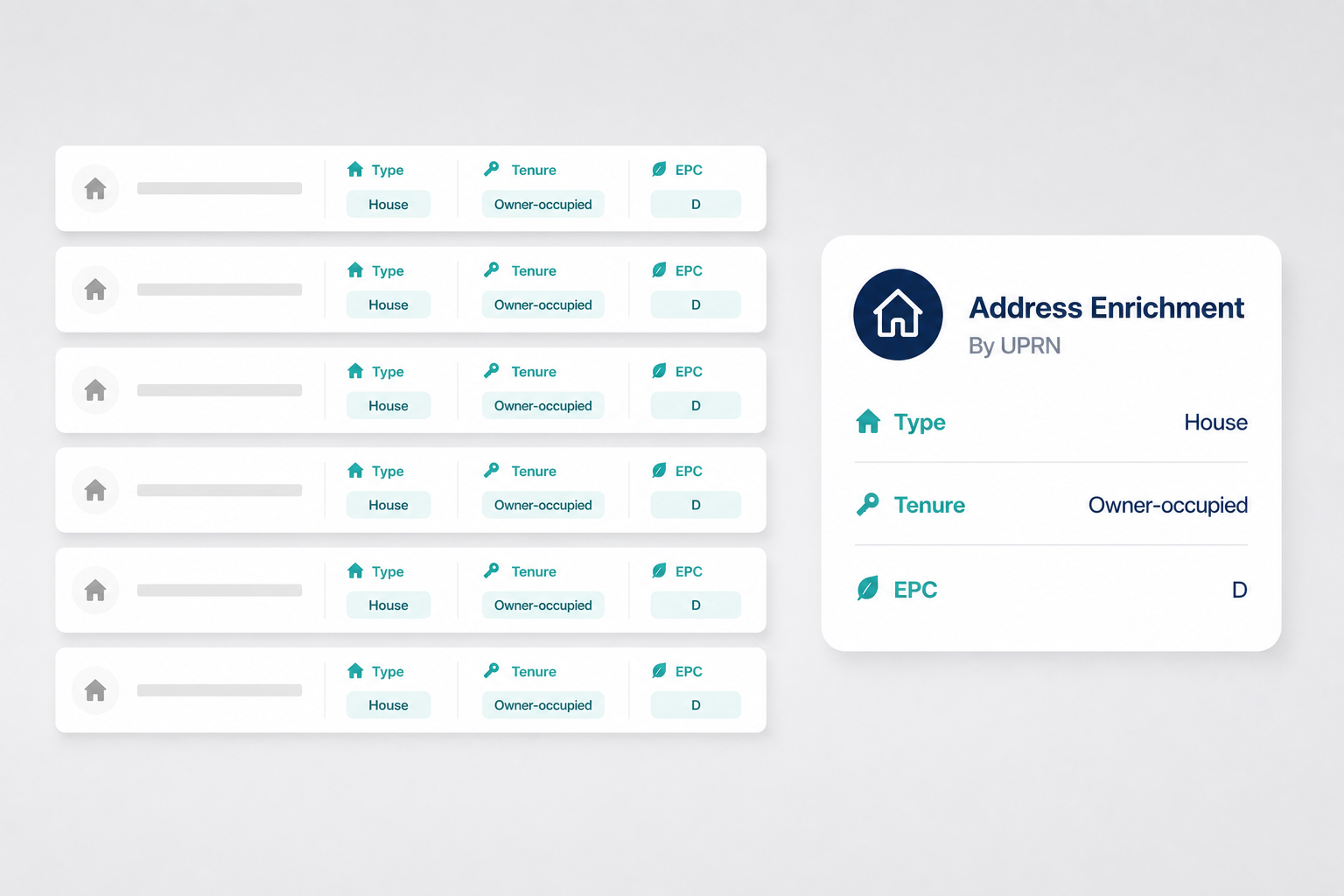
Matched by UPRN, each address in your estate can be attached to property attributes, tenure and EPC. The line of text becomes a property with a type, an age, an ownership tenure and an energy rating. Done in bulk across the whole file, that is the difference between a list and a book you can actually segment.
Once the attributes are attached, the questions you could not answer become straightforward. Which of my addresses are low EPC. Which are owned rather than rented. Which are the property types that suit a given proposition. None of that needs a fresh data purchase, because it is enrichment of records you already hold.
| Your record (illustrative) | Before | After enrichment |
|---|---|---|
| Address A | Text line only | House, owner-occupied, EPC D |
| Address B | Text line only | Flat, rented, EPC C |
| Address C | Text line only | House, owner-occupied, EPC F |
The example above is illustrative. The point is that enrichment is keyed to UPRN, so the attributes attach to the right property in your own file rather than to a postcode average.
Segment what you own before you buy what you do not
A segmented address base changes the order of the spend. Instead of buying reach and hoping it lands well, you first sort the estate you already have into the segments that matter for each campaign, then decide whether you actually need to buy more addresses to fill a gap. Often the campaign you were about to fund with fresh data can be run against your own enriched book.
The cheapest addresses to target well are the ones you already hold badly.
Keyed to UPRN throughout, the enriched base also stays clean over time, so a record enriched today can be matched against activity tomorrow without guessing which property it belonged to.
Segment the book you own before you spend on the book you do not.
Try the Address base enricher → · propalt.ai
Property attributes, tenure and EPC data are drawn from HM Land Registry, the EPC register and the Propalt intelligence layer. These are property signals, not eligibility decisions. Figures shown are illustrative. This article is general information for utility acquisition and planning teams.
Address base enricher
Bulk enriches your existing address estate by UPRN with property attributes, tenure and EPC, so you can segment the book you already hold before buying more addresses.
🎯 Best used for
Enriching and segmenting an existing address base
🔌 Propalt APIs used
get_property get_epc_fabric_by_postcode