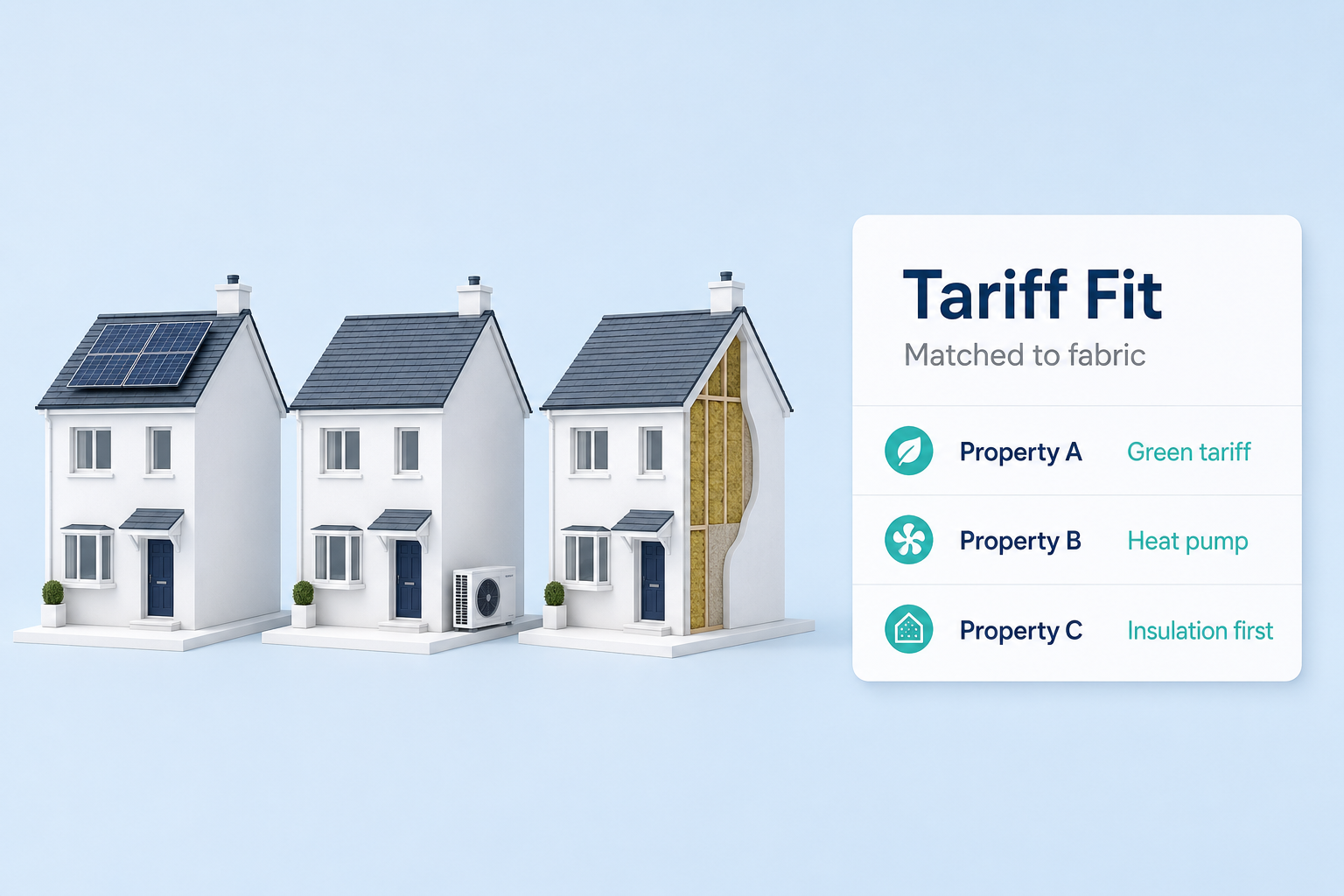
A heat pump offer to a solid-wall property with a new boiler is a wasted send
EPC rating and potential, wall and roof construction, insulation, glazing, and heating fuel and type decide which of heat pump, solar or green tariff a property can actually take.
Propalt Team · For utility companies
Every low-carbon proposition has a home it suits and a home it does not. A heat pump makes sense in a well insulated property with the right heating setup. Solar suits a suitable roof. A green tariff switch is an easy yes for a household already on the right footing. Send the wrong one to the wrong property and the response rate tells the story: the offer was never realistic for that building.
Broad demographic segments do not fix this, because two houses on the same street can have completely different fabric. One has been retrofitted, the other has original solid walls and a boiler fitted last year. A segment treats them as the same prospect. The building does not. Segmentation is not the problem. Segmenting on people when the proposition depends on the property is.
The fabric is on the record
The EPC register carries the detail that actually decides fit: current rating and potential rating, wall and roof construction, insulation, glazing, main heating fuel and system type. That is enough to tell a heat pump candidate from a property that needs insulation first, and a strong solar roof from one that is already efficient on gas.
Read against the fabric records held for each address, this turns a proposition list into a property list. The heat pump campaign goes to homes where the fabric supports it. The insulation-first message goes to homes with the gap between current and potential rating. The green tariff switch goes to households where the change is straightforward.
| Property (illustrative) | Current EPC | Potential EPC | Main heating | Best-fit proposition |
|---|---|---|---|---|
| Property A | C | B | Gas boiler | Green tariff switch |
| Property B | D | B | Old system | Heat pump candidate |
| Property C | E | C | Electric | Insulation first |
The example above is illustrative. What matters is that the fit comes from recorded fabric attributes, not a segment average, so the proposition matches the building it lands on.
Fewer offers, better received
When the proposition matches the fabric, the whole programme gets tidier. You stop sending heat pump offers to properties that cannot take one, and you stop treating an efficient home as a retrofit prospect. Each household hears about the thing that is actually realistic for their property, which is the version of the message most likely to convert and least likely to annoy.
The offer that fits the building is the one the household can actually say yes to.
The same fabric view also protects the customer relationship. Nobody is being pushed toward a change their property will not support, which matters when the conversation is about spending money on a home.
Match the offer to the fabric, not the segment.
Try the Tariff fit matcher → · propalt.ai
Property and fabric signals are drawn from the EPC register and the Propalt intelligence layer. These are property signals, not eligibility decisions. Figures shown are illustrative. This article is general information for utility acquisition and planning teams.
Tariff fit matcher
Reads EPC fabric attributes so heat pump, solar and green tariff propositions are matched to the properties that can actually take them.
🎯 Best used for
Matching low-carbon propositions to property fabric
🔌 Propalt APIs used
get_epc_fabric_by_property_id get_epc_fabric_by_postcode