Two of your biggest perils live in the fabric, not the postcode
Why wall, roof, glazing and heating detail belongs in the risk view.
Propalt Team · For insurance and risk teams
Escape of water and weather damage are among the perils that hurt most, and both are shaped by how the property is built rather than where it sits. A postcode tells you about flood and about neighbourhood claims patterns, but it says little about the pipework, the heating system or how well the fabric holds heat. Two houses on the same street can carry very different exposure once you look past the front door.
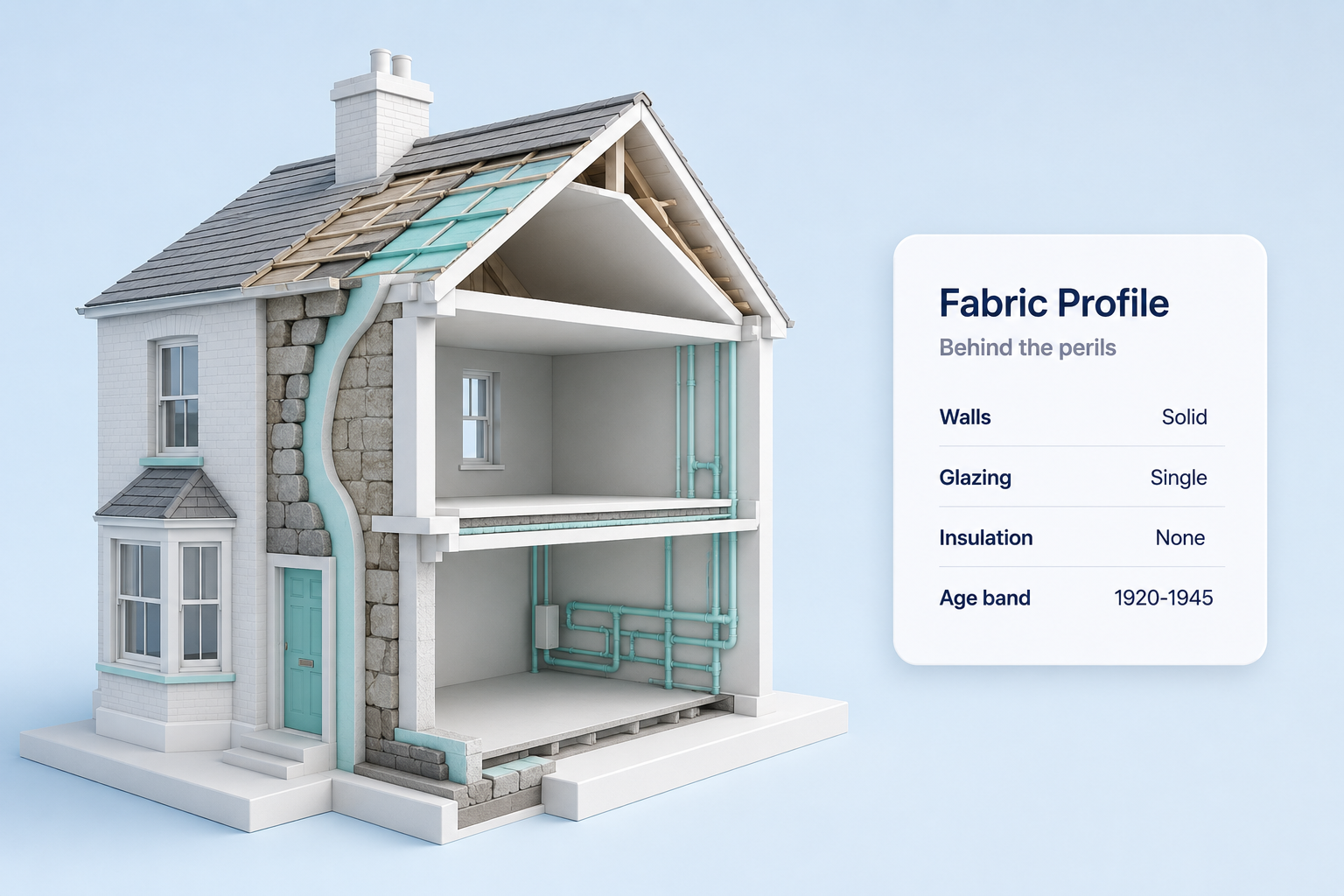
A fabric profile supplies that detail from the EPC register. Wall and roof construction, whether insulation is present, glazing type, the main heating system and its fuel, and the building's construction age band all come back attached to the property. These are the attributes that sit behind thermal-efficiency questions and, just as importantly, behind the water-escape exposure that older heating and plumbing tend to carry.
Reading the fabric for the perils it drives
The point is not to collect fabric attributes for their own sake, but to connect them to the perils they influence. An older building with an original heating layout is a reasonable proxy for escape-of-water exposure, because older pipework and joints fail more often. The certificate gives you the construction age band and the heating system type, but not the age of the system itself, so treat it as an indicator rather than an install date. Poor insulation and single glazing speak to thermal efficiency and to the weather resilience of the building. Solid walls behave differently from cavity walls when water gets in. Read together, these turn a flat address into a risk with texture.
| Fabric attribute (illustrative) | Value | Peril relevance |
|---|---|---|
| Construction age band | Before 1900 | Escape of water |
| Wall construction | Solid | Weather damage |
| Insulation present | No | Thermal efficiency |
| Glazing | Single | Weather damage |
The rows above are illustrative. The pattern they show is the useful part: each fabric attribute maps to a peril the pricing team already cares about, so the profile is read as risk signal rather than as an energy report.
What the EPC can and cannot tell you
Fairly stated, the EPC has limits. It reflects the property as assessed on the certificate date, which may be some years old, and a heating system may since have been replaced or a wall since insulated. The certificate describes what the assessor recorded, not necessarily the present state, and it was written for energy purposes rather than for underwriting.
The reframe is that the fabric profile is still far better than nothing, and usually better than a customer's own description. An EPC-derived age band for the heating system is a sounder basis for water-escape exposure than an unanswered question, and it improves the rebuild cost picture when read alongside floor area and construction. Treat it as the best recorded position, confirm the material cases, and you are pricing the building rather than guessing at it.
The postcode gives you the neighbourhood. The fabric gives you the risk.
Price the building you can describe, not the one you assume.
Try the Property fabric profile → · propalt.ai
Property and fabric attributes are drawn from the EPC register and the Propalt intelligence layer. Figures shown are illustrative. This article is general information for insurance professionals.
Property fabric profile
Returns wall and roof construction, insulation, glazing, main heating system and fuel, and construction age band, giving the fabric detail behind thermal-efficiency and water-escape exposure.
🎯 Best used for
Reading fabric detail behind water-escape and weather perils
🔌 Propalt APIs used
get_epc_fabric_by_property_id get_epc_fabric_by_postcode