Your model is only as honest as the factors you feed it
Why verified property attributes belong in the training set, tested before they reach live pricing.
Propalt Team · For insurance and risk teams
A pricing model inherits the quality of its inputs. If construction type, floor area and build age were self-reported at quote and never checked, the model has learned to price a description of the property rather than the property. That can still rate well on paper, because the error is baked in on both sides of the training split, but it leaves value on the table and it makes the book harder to defend when a factor is questioned.
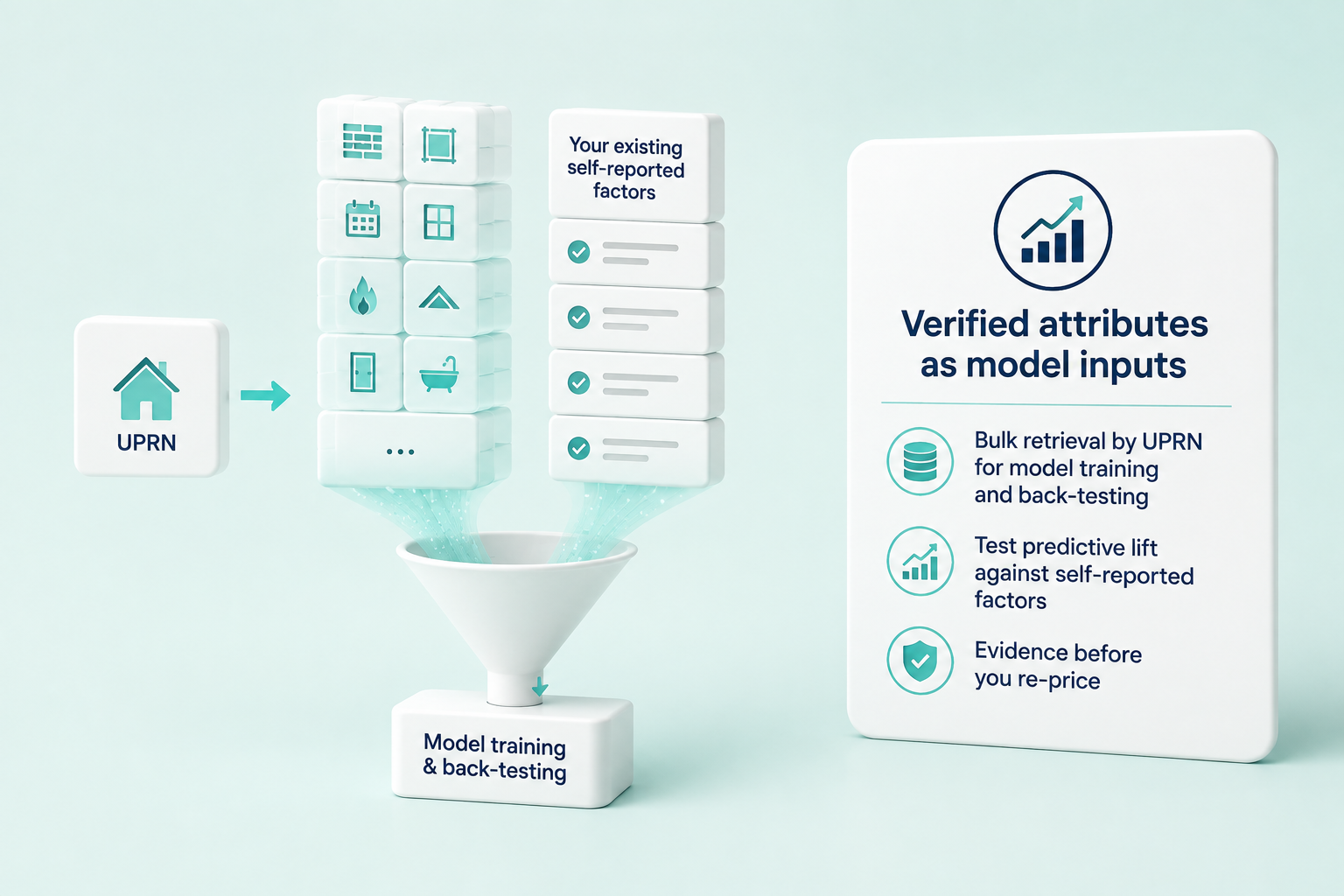
Verified rating factors change what goes into the model. Bulk retrieval by UPRN returns construction, fabric, floor area and build-age band from HM Land Registry and the EPC register for every risk in the training set, as a matter of record. The question is then empirical rather than theoretical: do these factors predict better than the ones you have been using?
Test the lift before you touch the price
The discipline that matters here is not swapping factors in and hoping. It is back-testing. Pull the verified attributes for a historical cohort, hold out a validation set, and measure whether a model trained on verified factors separates risk better than the incumbent trained on self-reported ones. Gini, lift by decile, loss-ratio spread across rating bands: use whatever your team already trusts, and let the verified inputs earn their place.
| Model input (illustrative) | Self-reported | Verified |
|---|---|---|
| Construction type | 71% | 98% |
| Floor area | Estimated | Recorded |
| Build-age band | 64% | 96% |
The figures above are illustrative and stand only for the shape of the gain: coverage and agreement rise when the factor comes from the register rather than a form. Whether that translates into predictive lift for your book is exactly what the back-test answers, and it will differ by peril and by segment.
A concession, and the reframe
To be fair, verified factors are not automatically better predictors of loss. A factor can be measured accurately and still carry little signal, and adding it can even hurt if it correlates with something the model already captures. That is real, and it is why this is a testing exercise, not a faith exercise.
The reframe is that verified factors give you a stable base to test from. When an input is accurate, any lift you find is genuine and any lift you do not find is a true negative rather than an artefact of noisy data. You end up knowing which attributes actually move loss, and you can carry that knowledge into a book re-score with confidence rather than committing a pricing change on a hunch.
Do not add a factor because it is verified. Add it because, verified, it still predicts.
Feed the model records, then let the back-test decide what stays.
Try the Verified rating factors → · propalt.ai
Property and fabric attributes are drawn from HM Land Registry, the EPC register and the Propalt intelligence layer. Figures shown are illustrative. This article is general information for insurance professionals.
Verified rating factors
Retrieves verified property attributes in bulk by UPRN for model training and back-testing, so predictive lift can be measured against self-reported factors before any pricing change.
🎯 Best used for
Testing verified attributes as pricing model inputs
🔌 Propalt APIs used
search_properties get_property get_epc_fabric_by_property_id