The problem file rarely announces itself on day one
Why the first hour on a matter is the cheapest hour to spend.
Propalt Team · For conveyancers
Every conveyancer has met the file that looked ordinary at instruction and turned difficult six weeks in. A short lease nobody flagged. A coal reference that arrived with the search pack when the client had already booked removals. The work was always going to be there. It just surfaced at the point where it costs the most goodwill and the most time.
The honest counterpoint is that you cannot run a full due diligence exercise on every instruction before you have even opened the file. Nor should you. What you can do is run a fast indicator pass, so that the handful of matters carrying early risk are visible on day one and the rest can proceed on the normal track. Triage is not the search. It is the decision about which files deserve a closer look sooner.
What a day-one score actually reads
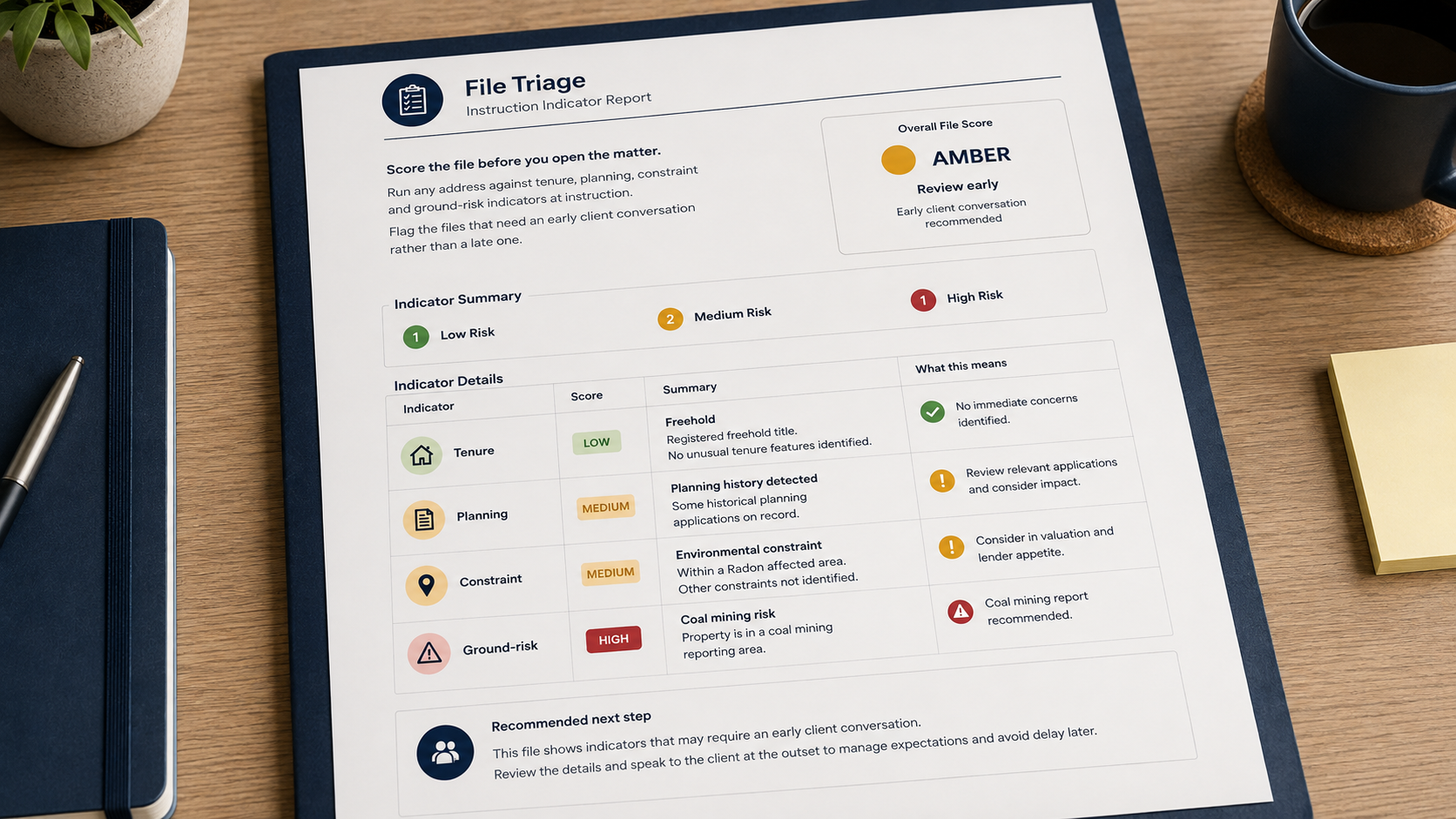
A useful triage pass looks at the same address from four angles at once. Tenure and ownership from the register tell you whether you are dealing with a lease, and whether the ownership structure is going to complicate things. Planning history shows recent or pending applications on the property. Constraint and ground-risk indicators, drawn from coal and non-coal mining area checks, tell you whether the location sits over historic workings that will need a specialist report.
None of this replaces your formal searches or your enquiries. It orders your day. A file that reads clean on all four can move on the standard timeline. A file that lights up on two or three is the one you want to raise with the client in week one.
| Address (illustrative) | Tenure | Planning activity | Ground risk | Triage flag |
|---|---|---|---|---|
| 12 Elm Road | Freehold | None | None | Green |
| Flat 4, Mill Court | Leasehold | Recent app | None | Amber |
| 8 Colliery View | Freehold | None | Coal area | Red |
The table is illustrative. The value is that the ordering comes from register and authority data on the specific address, not a postcode-level guess, so the first client call you make is to the file that most needs it.
The early conversation you would rather have
Material information duties and your SRA or CLC obligations both point the same way: the client is better served when a known issue is raised early and framed calmly. A short lease flagged in week one is a planning conversation. The same short lease discovered when the buyer's lender objects is a crisis.
The file that costs you a Friday afternoon in month two was usually visible in the first hour of month one.
Triage does not remove work from the file. It moves the difficult part forward, to the point where you have time to handle it well.
Score the file first, then open it properly.
Try the Day-one file triage → · propalt.ai
Tenure, planning, constraint and ground-risk indicators are drawn from HM Land Registry, local planning authority records, the Mining Remediation Authority, formerly the Coal Authority, and the Propalt intelligence layer. Figures shown are illustrative. This article is general information for conveyancing professionals.
Day-one file triage
Runs any address against tenure, planning, constraint and ground-risk indicators at instruction, and returns a simple flag so the files needing an early client conversation are visible on day one.
🎯 Best used for
Prioritising new instructions and spotting early risk
🔌 Propalt APIs used
get_property get_planning_applications get_coal_area get_mining_area