The site that fails a constraint check should fail it before the invoice
Why screening constraints by coordinate is the first hour of work, not the last.
Propalt Team · For property developers
Some sites are dead on arrival, and the tragedy is how much they cost to bury. A plot sitting over a former coal working, or inside a constraint that rules out the density your numbers depend on, will not become viable no matter how good the scheme. Yet the constraints that would have told you this are often the last thing checked, after the appraisal is built and a consultant has already been paid to confirm the obvious.
Screening should be the first hour, not the last. Active planning constraints, the defined coal area and non-coal mining hazard are all knowable by coordinate at the outset, before an appraisal exists to be undermined. The point is not to replace the specialist report you will still need on a live site. It is to stop paying for reports on sites that were never going to work.
Three checks that decide whether to spend anything
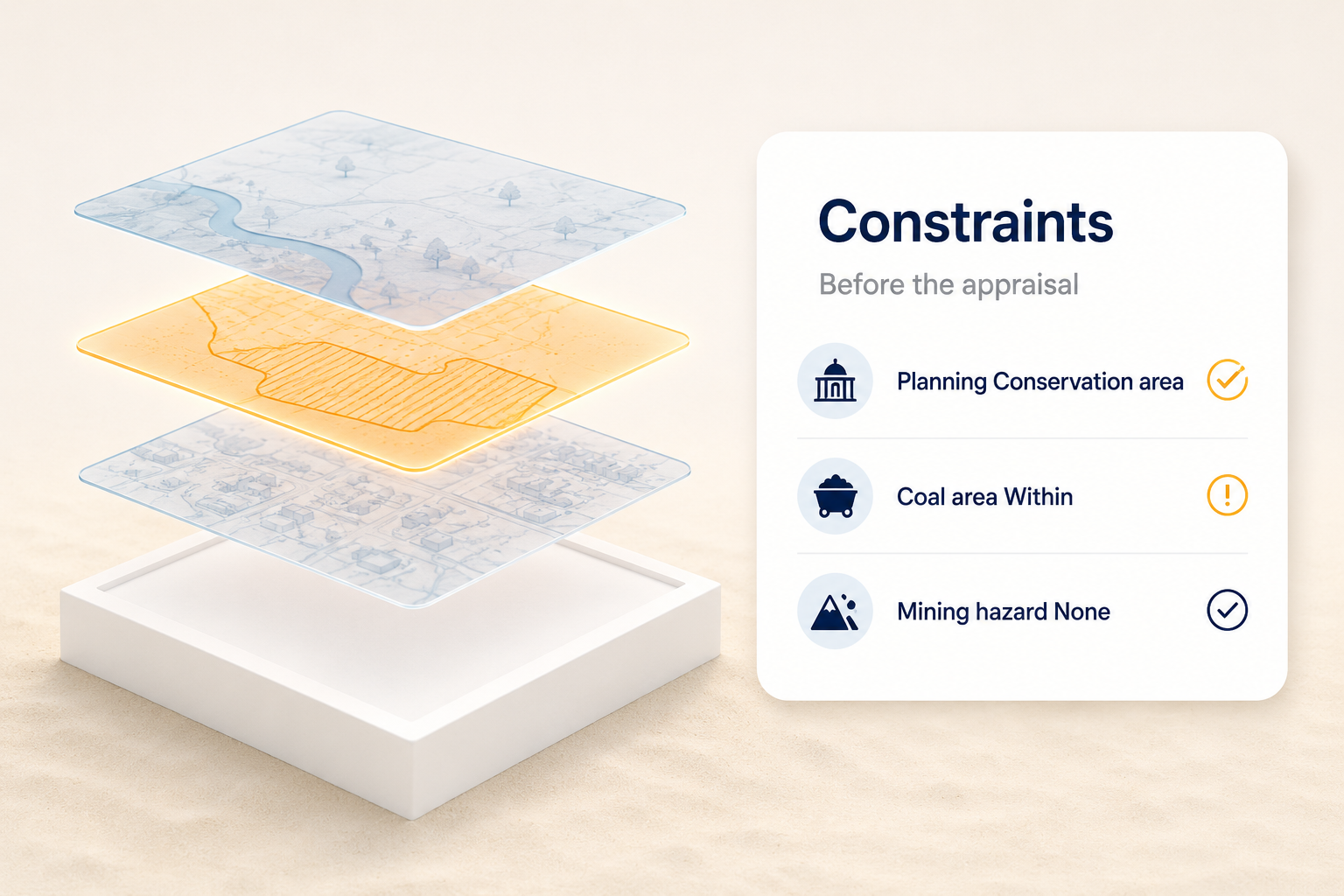
Each check answers a different question, and any one of them can end the conversation. Active planning constraints tell you what the policy framework allows on the plot. The coal area check, maintained by the Mining Remediation Authority, formerly the Coal Authority, flags whether the site sits within a defined coalfield with the ground risk and reporting that implies. Non-coal mining hazard captures the other legacy workings that do not show up in a coal search but can be just as decisive for foundations and cost.
| Check (illustrative) | What it screens for |
|---|---|
| Active planning constraint | Policy limits on the plot |
| Defined coal area | Ground risk within a coalfield |
| Non-coal mining hazard | Other legacy workings by coordinate |
The table above is illustrative. The value is in running all three at once, at coordinate level, so that a site failing any of them is set aside before it consumes an appraisal, an architect's time or a consultant's fee. A red flag in the first hour is worth far more than the same flag in the third week.
Kill the bad site, protect the good spend
The fair objection is that a constraint screen is not a formal ground investigation, and it is not. A site that clears this screen still needs the proper searches and specialist reports before you commit. What the screen does is different: it removes the sites that were never worth those reports, so your diligence budget goes only on plots with a real chance of standing up.
That reordering is where the money is saved. Instead of appraising ten sites and discovering late that three were unviable, you screen ten in an afternoon, carry the seven that survive into a proper appraisal, and put no GDV modelling behind the three that failed. The consultant fee is spent on sites that deserve it.
A site that fails a constraint check should fail it in the first hour, not after the invoice.
That is the discipline a constraint screen enforces. It is cheap, it is fast, and it protects every pound of diligence spend that comes after.
Screen the site before you spend on it.
Try the Site constraint screener → · propalt.ai
Planning constraint, coal and mining hazard data is drawn from the Mining Remediation Authority, formerly the Coal Authority, planning constraint records and the Propalt intelligence layer. Figures shown are illustrative. This article is general information for property development professionals.
Site constraint screener
Checks active planning constraints, Mining Remediation Authority coal area and non-coal mining hazard by coordinate, so an unviable site is set aside in an afternoon rather than after a consultant fee.
🎯 Best used for
Rapid site screening before appraisal
🔌 Propalt APIs used
get_planning_constraints get_coal_area get_mining_area