The letter went to the site, and the site cannot say yes
Why tracing ownership to the entity, not the postcode, decides whether the approach lands.
Propalt Team · For property developers
A site does not make decisions. A person does, or a board does, and often that person sits behind a company that sits behind another company. Send your approach to the address and it reaches a tenant, a caretaker or an empty building. The one letter you needed to write, to the individual who can actually agree to sell, never gets written, because you never knew their name.
Tracing ownership is not a formality you do after agreeing a deal. It is the step that decides whether the deal is reachable at all. Registered title tells you the legal owner, and where that owner is a company, Companies House tells you who stands behind it and what else they hold. Skip that layer and you are negotiating with a doormat.
From a title number to a decision maker
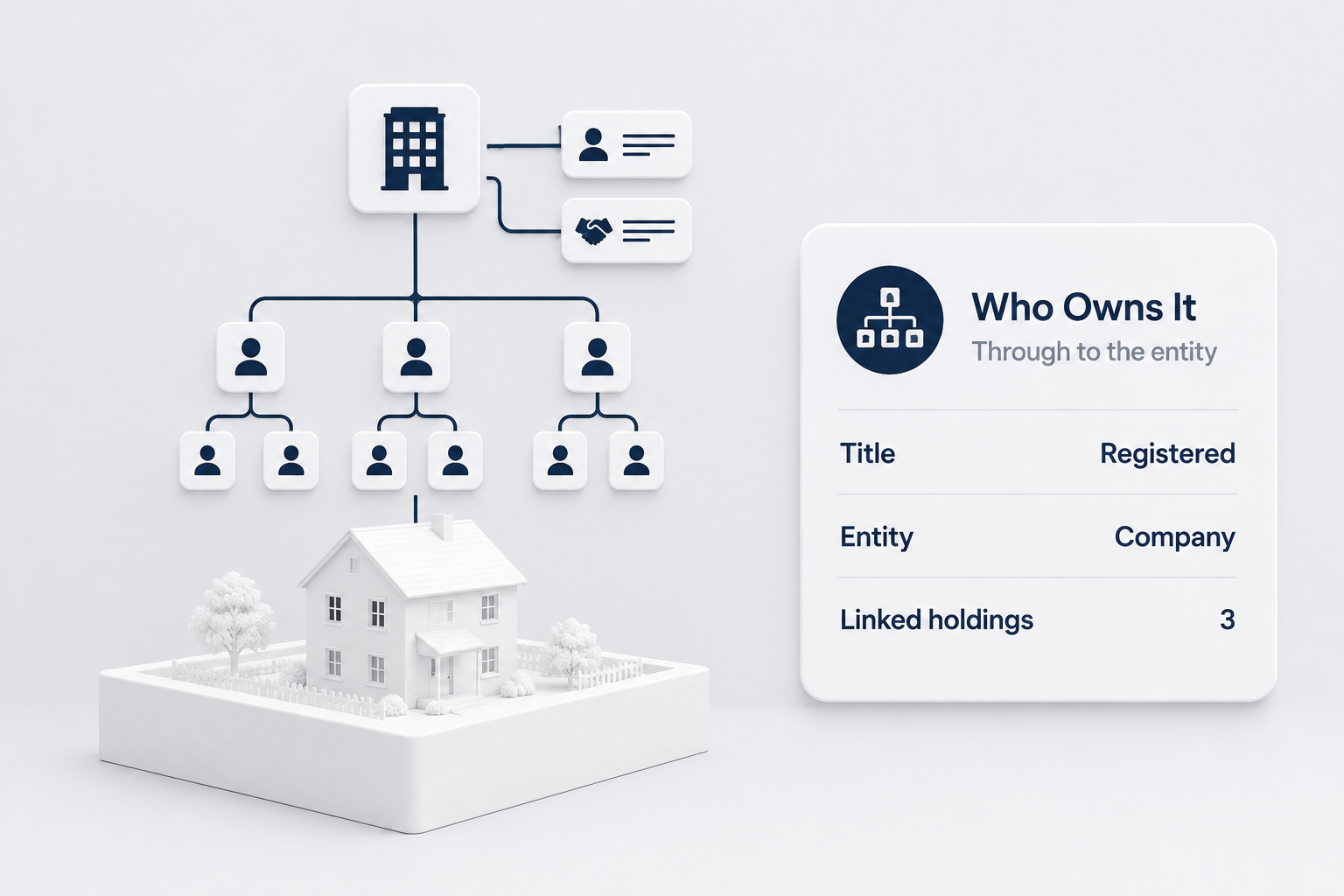
The chain usually runs the same way. The site is held by a limited company. That company has directors and persons with significant control. Those same people frequently sit behind other holdings, which is how you learn that the plot you are chasing is one of several the same owner controls nearby. Following that chain properly changes both who you write to and what you say.
| Layer (illustrative) | What it tells you |
|---|---|
| Registered title | The legal owner of the plot |
| Companies House entity | The company and its officers |
| Linked holdings | Other assets the same owner controls |
The table above is illustrative. The value is not in any single record but in the connection between them. Once you can see that the same entity holds three adjacent parcels, a single-site approach becomes an assembly conversation, and the person you write to is the one who can actually say yes to all of it.
The approach that reaches a person
There is a reasonable objection here: a well-addressed letter to the site sometimes gets forwarded, and occasionally that is enough. It is, occasionally. But relying on forwarding is relying on a stranger to do your sourcing for you, and it fails silently when it fails. Tracing to the entity removes the guesswork. You write to the named decision maker, you reference the specific holding, and you do it before a competitor who is still posting letters to buildings.
This is also the point where compliance and commercial advantage meet. Knowing exactly who owns a site, through the registered title and the corporate record, is both the right way to approach an owner and the faster route to a deal. One diligence step gives you both.
A building cannot agree to sell. Trace the owner, and you are talking to someone who can.
Ownership tracing is the quiet groundwork that makes every later step, from approach to Section 106 negotiation, rest on a solid footing. Get the owner right and everything downstream is real.
Write to the owner, not to the building.
Try the Site ownership tracer → · propalt.ai
Ownership and corporate-holding data is drawn from HM Land Registry, Companies House and the Propalt intelligence layer. Figures shown are illustrative. This article is general information for property development professionals.
Site ownership tracer
Traces a site through registered title to the Companies House entity and its linked corporate holdings, so an approach reaches the named decision maker rather than the property address.
🎯 Best used for
Owner identification and approach targeting
🔌 Propalt APIs used
get_property get_market_activity_get_company_properties