The leaflet drop you paid for landed on houses the product cannot fit
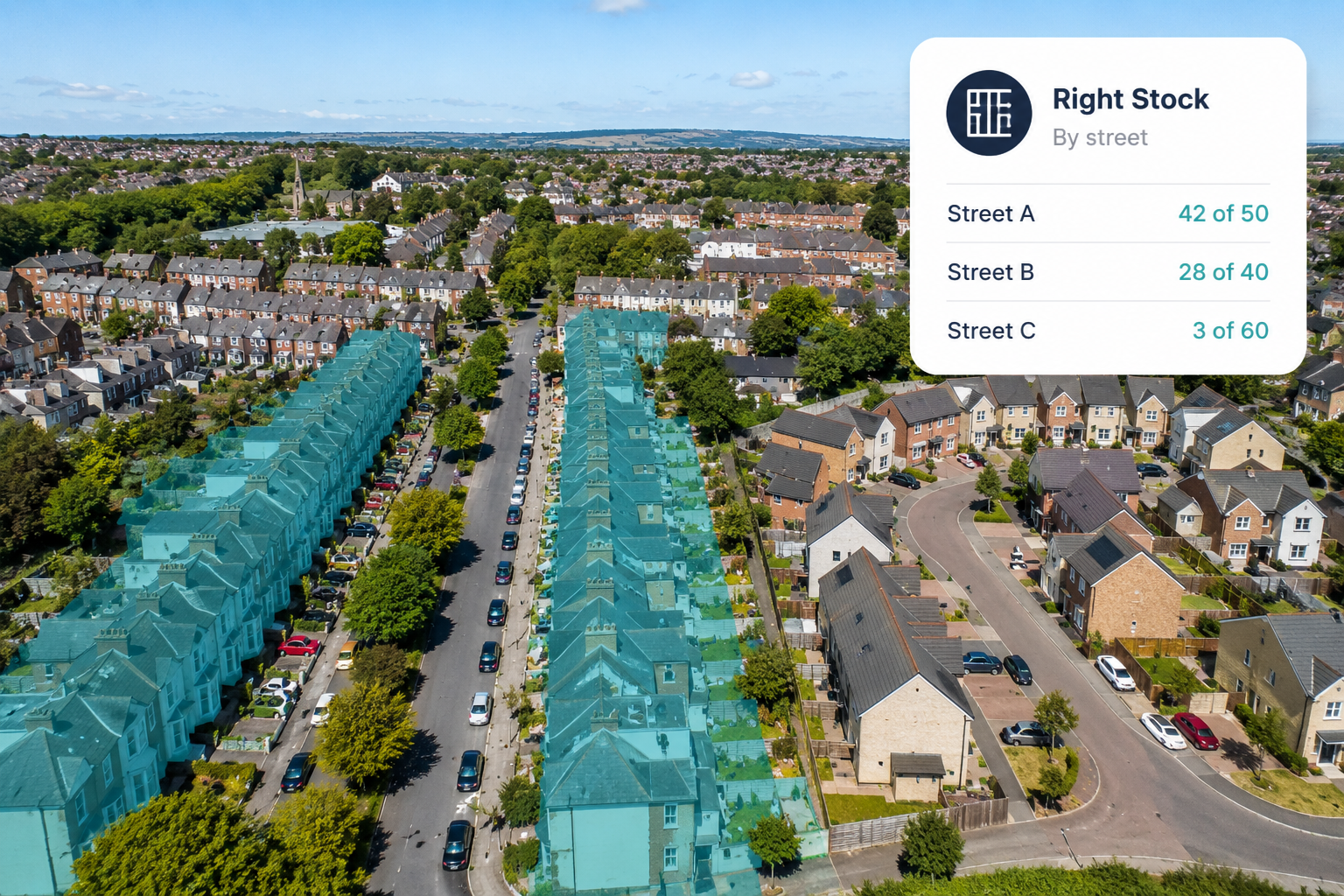
Qualifying properties mapped by street and outcode from fabric records, exported to CSV so a print run follows the housing stock.
Propalt Team · For home improvement and retrofit installers
A blanket leaflet drop across an outcode is priced by the thousand and read by the few it actually suits. Half the doors are new-build houses already at a high EPC band with nothing to sell them. A fair share are flats where your measure does not apply. The print run was the same either way, but most of it was posted through the wrong doors.
Leafleting still works. Untargeted leafleting is what fails. The postcode is not the unit that matters, the housing stock is, and streets vary enormously within a single outcode. One road of solid-wall terraces with old boilers is a different prospect from the cul-de-sac of new builds two turnings away.
The street, not the postcode
Break the area down to the level the product cares about. Fabric records let you see which streets hold the stock your measure suits: the wall types that take insulation, the roofs that take solar, the heating systems ready for an upgrade. Map qualifying properties by street and by outcode, and the same budget stops spreading thin across everything and concentrates on the roads where the leaflet has something to say.
The result is a door drop that follows the building, not the boundary. You still print the same number of leaflets. You just post them where the housing stock gives them a reason to be read.
| Street (illustrative) | Dominant stock | Qualifying properties | Door drop |
|---|---|---|---|
| Street A | Solid-wall terraces | 42 of 50 | Priority |
| Street B | 1930s semis, cavity | 28 of 40 | Include |
| Street C | Recent new builds | 3 of 60 | Skip |
The table above is illustrative. What matters is that the ordering comes from EPC fabric records at street level, so the print run is aimed at the addresses where the product fits rather than spread evenly across the map.
Export and drop
The targeter returns qualifying properties by street and outcode and exports them straight to CSV, ready for the round or the mailing house. The team walks a shorter list of better streets, and the cost per genuine enquiry falls because fewer leaflets are wasted on stock that was never a candidate.
The same print run, posted through the right doors, is a different campaign.
That is the point of targeting on housing stock. You are not spending more on the drop. You are spending the same and aiming it, so the leaflet lands where the product belongs and the enquiries that come back are worth following up.
Print the same run. Drop it on the right streets.
Try the Right-stock street targeter → · propalt.ai
Property and fabric data is drawn from the EPC register and the Propalt intelligence layer. Results are screening indicators, not eligibility decisions. Figures shown are illustrative. This article is general information for home improvement professionals.
Right-stock street targeter
Maps qualifying properties by street and outcode from fabric records and exports them to CSV, so a door drop follows the housing stock the product suits rather than the postcode boundary.
🎯 Best used for
Targeted leaflet drops and door-to-door rounds
🔌 Propalt APIs used
search_properties get_epc_fabric_by_postcode