Most portals sort by price. You buy on return.
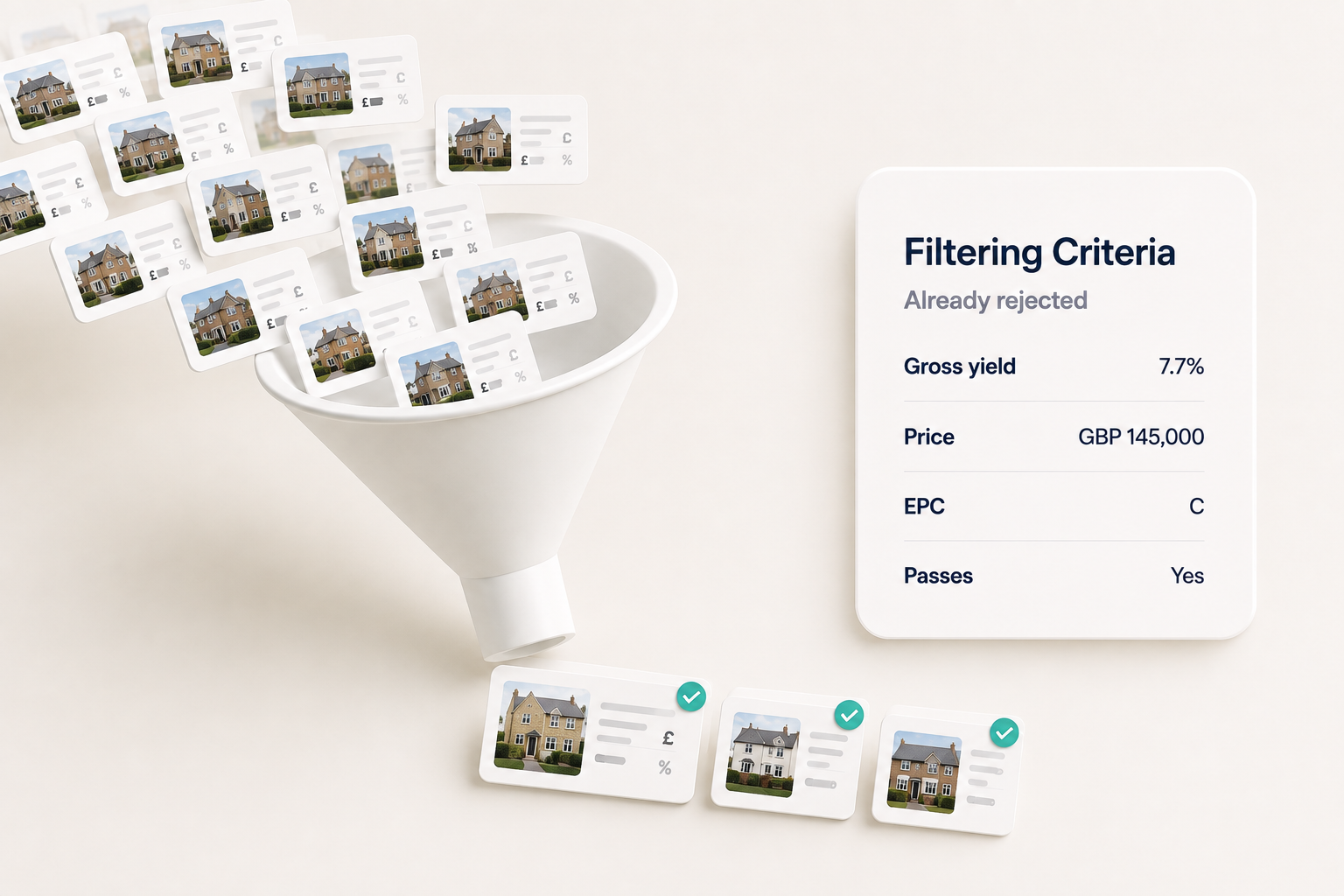
A gross yield floor, price ceiling, bedroom range, tenure and minimum EPC band applied together, so the list returned has already been rejected against the investor's own criteria.
Propalt Team · For property investors
The way most portal searches work is backwards for a buy-to-let investor. You set a maximum price and a minimum bedroom count, then open thirty tabs and calculate the yield on each one by hand. The asking price is the headline, so the asking price becomes the filter. But the asking price is not what you are buying. You are buying an income stream against the capital you put in, and the number that describes that is the yield.
A cheaper property is not a better one if the achievable rent is thin. A higher-priced flat in a stronger rental pocket can carry a better gross yield and pass an interest cover ratio test more comfortably. Sorting on price hides all of that until you have already spent the evening working through listings that were never going to clear your floor.
Reject on your criteria before you read a single listing
The point of yield-first sourcing is that the rejection happens before you look. You set the terms once: a gross yield floor, a price ceiling, a bedroom range, freehold or leasehold, and a minimum EPC band so nothing below the MEES threshold slips onto the list. Every property that comes back has already been measured against all of those at the same time. What lands in front of you is a shortlist, not a search result.
That EPC filter matters more than it did a few years ago. A property sitting below the required band is not a bargain if the retrofit to reach the standard eats the first three years of return. Screening it out at the sourcing stage saves you from building a spreadsheet around a number you would later have to strike through.
| Area (illustrative) | Asking price | Est. rent pcm | Gross yield | EPC | Passes filter |
|---|---|---|---|---|---|
| Two-bed terrace | £145,000 | £925 | 7.7% | C | Yes |
| Two-bed flat | £130,000 | £700 | 6.5% | D | Yes |
| Two-bed terrace | £120,000 | £575 | 5.8% | F | No |
The table is illustrative. The cheapest property fails, because it fails on both the yield floor and the EPC band, and it fails before you ever open it.
One question, a list you can act on
Instead of a search you refine ten times, you ask once and describe the deal you actually want. The area, the yield you need, the most you will pay, the size, the tenure and the energy band go in together. The comparables and the valuation sit behind the estimate, so the rent figure is grounded in what similar properties nearby actually let and sold for, rather than an agent's optimistic round number.
A search that returns fifty properties has not saved you time. A search that returns five you would genuinely buy has.
The result is a sourcing run that respects how you think. You lead with return, the filter does the rejecting, and the reading time goes to the handful worth a viewing.
Source on the number you buy on.
Try the Yield-first deal sourcer → · propalt.ai
Property, valuation and comparable data is drawn from HM Land Registry, the EPC register and the Propalt intelligence layer. Figures shown are illustrative. This article is general information for property investors.
Yield-first deal sourcer
Filters any area of England and Wales by yield threshold, price ceiling, bedrooms, tenure and EPC band in a single question, returning only properties that already clear your criteria.
🎯 Best used for
Off-market and on-market sourcing by return
🔌 Propalt APIs used
search_properties get_valuation_by_property_id get_comparable