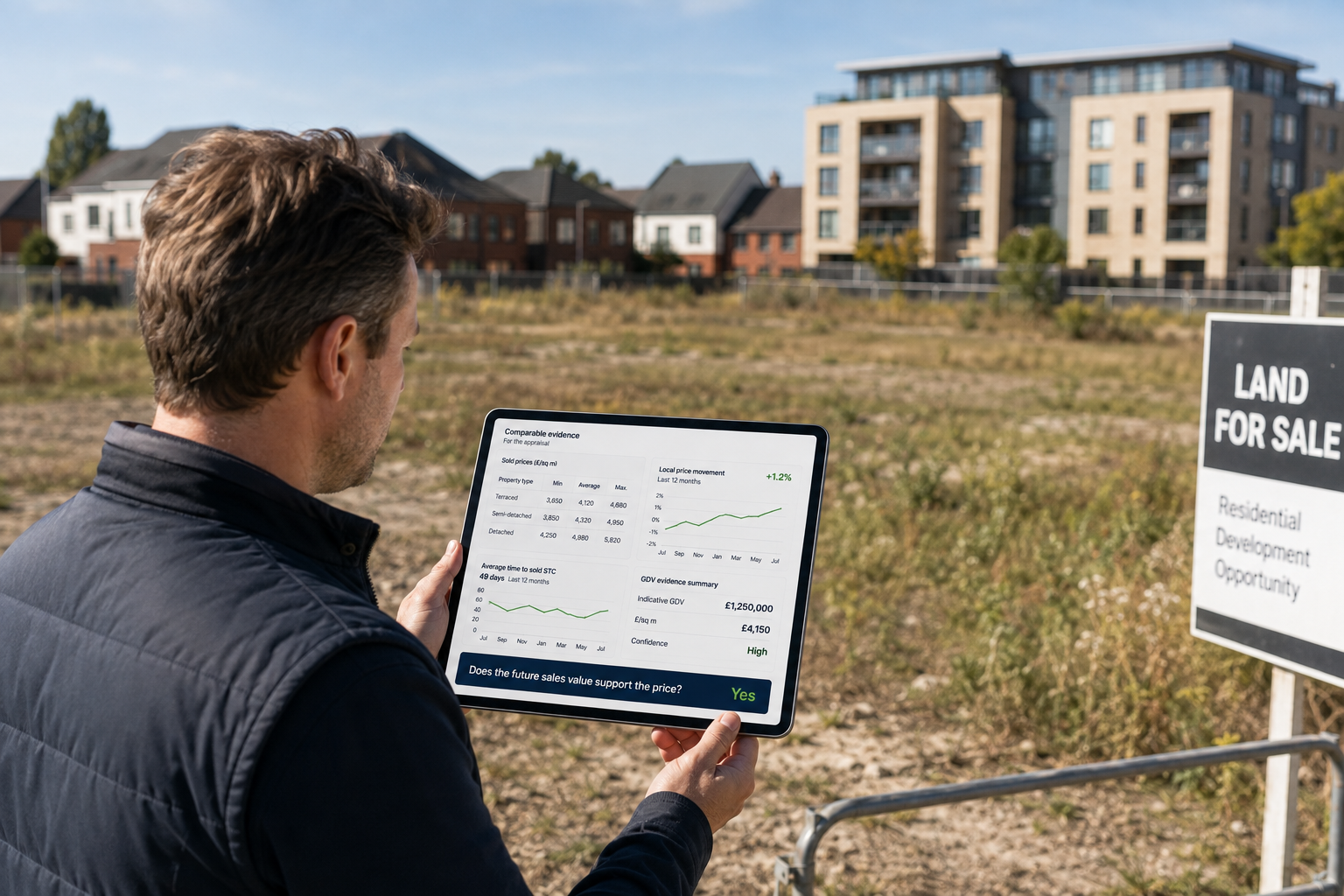
The GDV is the number the whole appraisal turns on, and often the weakest
Sold prices, achieved values by type and floor area, local price movement and time to sold subject to contract put evidence behind the GDV line.
Propalt Team · For property developers
Gross development value is the figure everything else in the appraisal leans against. Land price, finance, the developer's return, the whole viability case: all of it is calculated backwards from the GDV. And yet the GDV is frequently the least evidenced line on the page, a confident round number pulled from a nearby asking price or a sense of what the area does. When the top line is a guess, every number under it inherits the guess.
The remedy is not more precision for its own sake. It is evidence. Sold prices, achieved values broken down by property type and floor area, the direction the local market has moved and how long stock is taking to go under offer. Put those behind the GDV and it stops being an assumption you defend and becomes a figure you can show.
Four inputs that turn an assumption into a case
Each input answers a question a lender or partner will eventually ask. Sold prices tell you what buyers have actually paid, not what sellers hoped for. Achieved values by type and floor area let you match your proposed units to genuine comparables rather than an area average. Local price movement tells you whether recent sales are still a fair guide or need adjusting. And average time to sold subject to contract tells you how quickly the units are likely to turn, which feeds directly into the finance you carry.
| Input (illustrative) | What it evidences |
|---|---|
| Sold prices | What buyers actually paid |
| Achieved value by type/size | Comparables matched to your units |
| Local price movement | Whether recent sales still apply |
| Time to sold STC | How fast units are likely to turn |
The table above is illustrative. The strength of a GDV line comes from combining these rather than leaning on any one. A sold price without a floor area is hard to apply; a floor area without market direction can be stale. Together they build a figure you can stand behind.
The number you can show beats the number you assert
It is worth conceding that no comparable set removes all uncertainty. Markets move between the appraisal and the sale, and a scheme sells into whatever conditions arrive. But an evidenced GDV manages that uncertainty rather than ignoring it, because you can see the direction of travel and the pace of sales and adjust before you commit, instead of discovering the gap when the units sit unsold.
This is also what changes the conversation with a funder. A GDV backed by sold comparables, matched by type and size, with market movement and absorption attached, is a case rather than a claim. It is the difference between asking a lender to trust your number and showing them where it came from.
A GDV you can show beats a GDV you assert, every time the funder asks where it came from.
That is the point of building evidence into the top line. The appraisal is only as sound as the number it turns on, and that number deserves the most evidence, not the least.
Evidence the top line before you build the appraisal on it.
Try the GDV evidence builder → · propalt.ai
Sold price, achieved value and market movement data is drawn from HM Land Registry and the Propalt intelligence layer. Figures shown are illustrative. This article is general information for property development professionals.
GDV evidence builder
Assembles sold prices, achieved values by property type and floor area, local price movement and average time to sold subject to contract, so the GDV line in an appraisal carries evidence rather than assumption.
🎯 Best used for
Evidencing GDV in a development appraisal
🔌 Propalt APIs used
get_comparable get_market_analysis get_quarterly_market