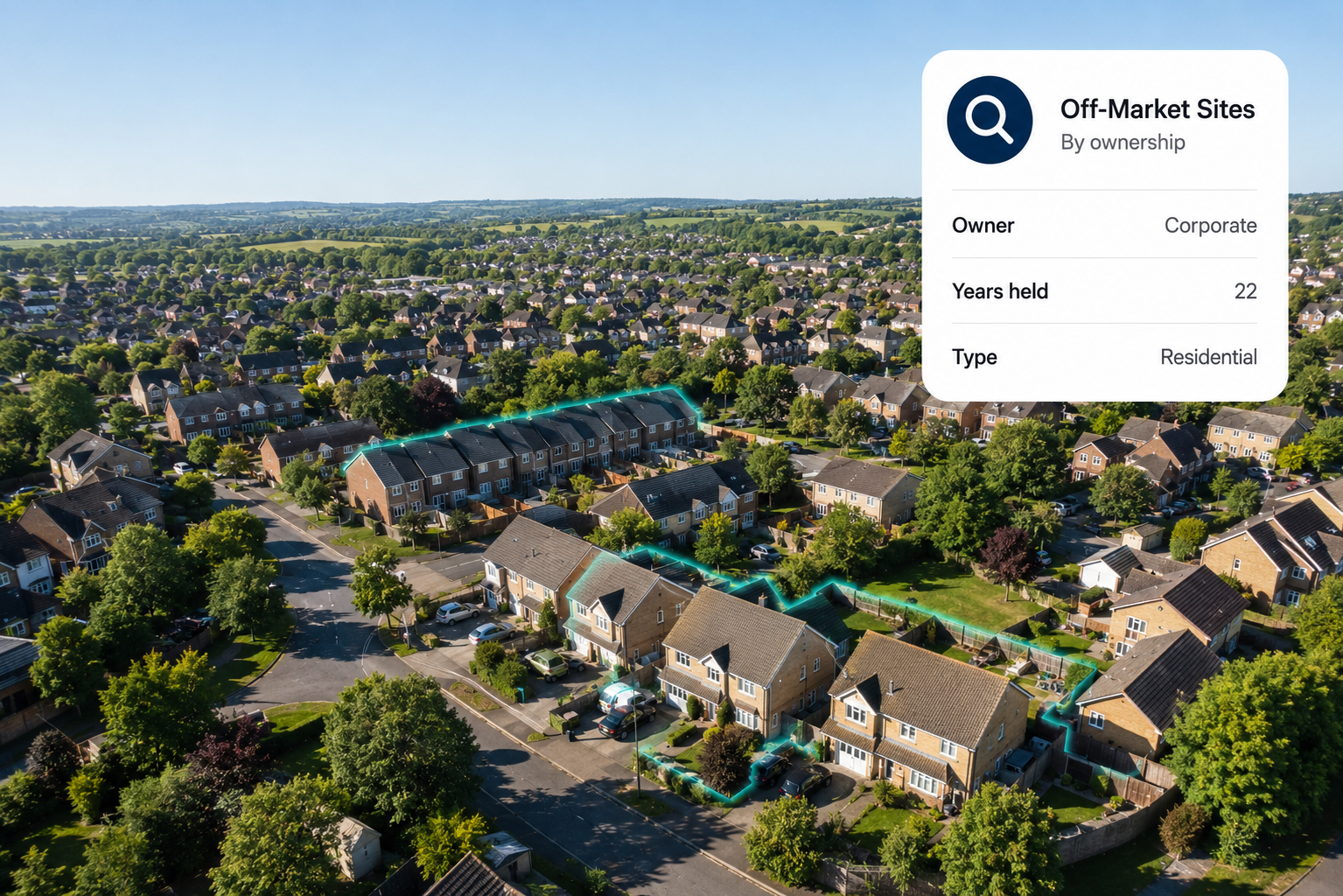
The best site on your patch is not for sale, and never has been
Tenure, ownership type, holding period and property type surface long-held plots and corporate-owned assets that have never been marketed.
Propalt Team · For property developers
The plot you want is rarely the one with a board on it. It is the tired warehouse held by the same company for twenty years, the row of garages behind the high street, the large rear garden on a corner that no one has thought to split. None of these appear on a portal, because the owner has never picked up the phone to an agent. If you wait for the listing, you are bidding against everyone else who saw the same listing.
Site finding by listing is a queue. Site finding by ownership pattern is a search. The difference is that the second one starts from what the land is and who holds it, rather than from whether someone happens to be selling this month. The signals that predict a willing seller, or a plot ripe for assembly, sit in the ownership record long before any decision to market.
The patterns that separate a plot from a prospect
Not every long-held plot is a prospect, and a corporate owner is not automatically a motivated one. The point is to filter a whole area down to the handful of sites worth a first approach. Three signals do most of the work: tenure and property type tell you what could physically be built or converted, holding period tells you whether the owner is likely near a decision, and ownership type separates the private individual from the company that may be winding down or consolidating.
| Site (outcode illustrative) | Ownership type | Years held | Property type | Priority |
|---|---|---|---|---|
| Site A | Corporate | 22 | Industrial | High |
| Site B | Corporate | 11 | Commercial | Medium |
| Site C | Private | 4 | Residential | Low |
The table above is illustrative. What matters is that the ranking comes from real ownership records rather than a guess about who might sell, so the first letters you send land with owners whose holding pattern actually suggests movement. A long-held, corporate-owned industrial plot is a very different conversation from a house bought four years ago.
One search, a pipeline you own
A listing is shared with every developer in the region the moment it goes live. A site surfaced by ownership pattern is yours alone until you make the approach. That is the whole value of working the layer underneath the portal. You are not competing on price for something already in play; you are reaching the owner before the decision to sell has been made, with a specific proposition about a specific plot.
Run the search across an outcode and you get more than one lead. You get a ranked set of long-held and corporate-owned assets, each with tenure, holding period and property type already attached, ready to work through week by week.
The site with no board on it is the one your competitor has not found either.
That is the case for site finding on ownership data. The GDV you can build on a plot no one else has spotted is worth more than the same GDV fought over in an open bidding round.
Search the ownership, not the listings.
Try the Off-market site finder → · propalt.ai
Ownership, tenure and holding-period data is drawn from HM Land Registry, Companies House and the Propalt intelligence layer. Figures shown are illustrative. This article is general information for property development professionals.
Off-market site finder
Searches an area by tenure, ownership type, holding period and property type, returning long-held plots and corporate-owned assets that have never been marketed, ranked for first approach.
🎯 Best used for
Off-market site sourcing and land assembly
🔌 Propalt APIs used
search_properties get_property get_market_activity_get_company_properties