The inspection goes faster when you already know what to expect
Why the fabric picture belongs in your hands before the front door opens.
Propalt Team · For surveyors
Arriving cold at an inspection means the first twenty minutes go on orientation: what the walls are made of, whether there is insulation, what the heating system is and roughly how old it might be. None of that is wasted work, but much of it is recoverable before you leave the office. The building tells you what it is when you get there. The record can tell you most of it before you set off.
The concern with pre-reading a property is always the same, and it is a fair one: the register is not the survey, and no field on a certificate replaces what you see and touch on site. Agreed. The purpose here is not to pre-empt your professional inspection. It is to walk in already oriented, so your attention on site goes to the things that need a surveyor's eye rather than to establishing the basics.
The fabric picture, before you set off
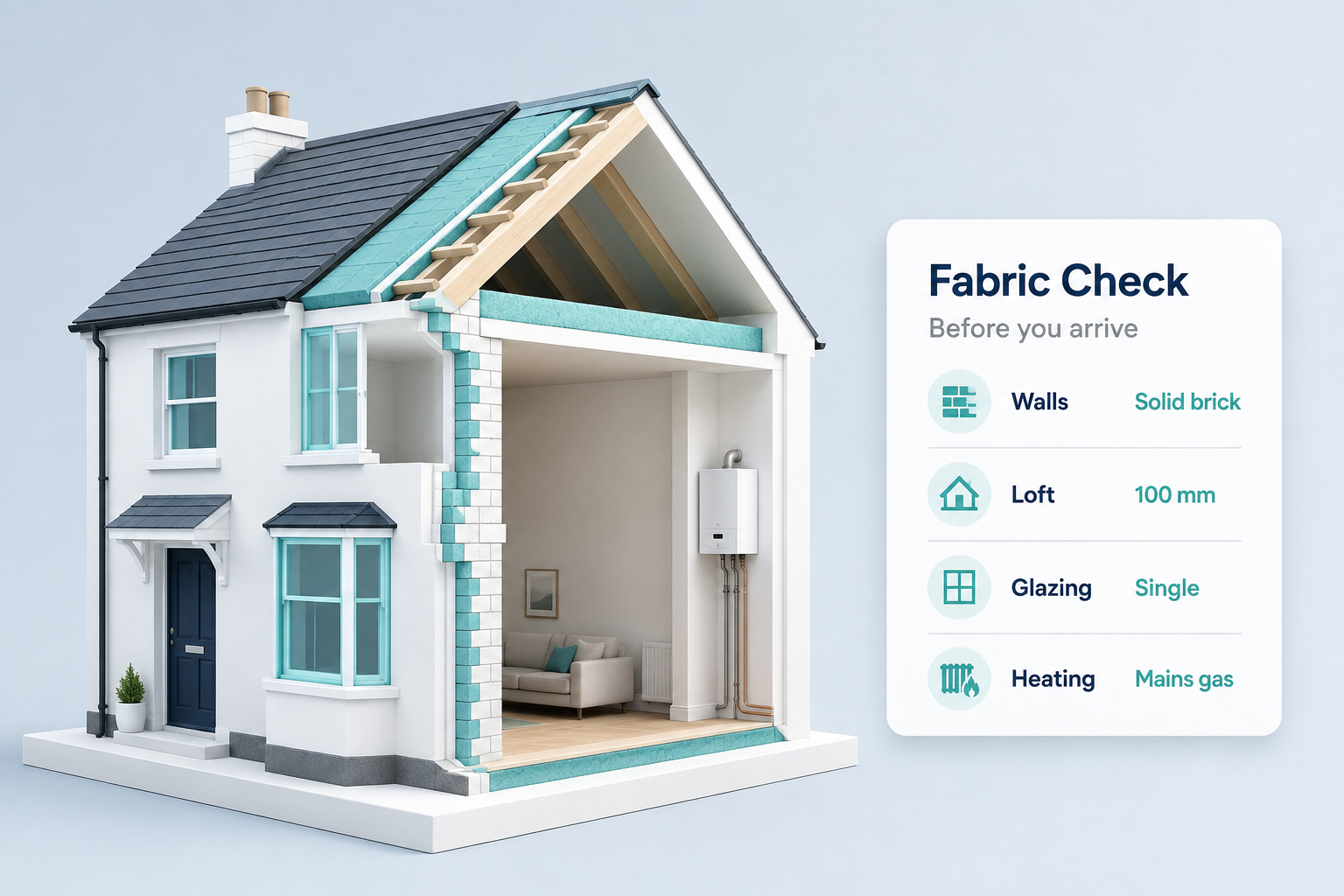
This skill returns the EPC-derived fabric profile for the address: wall construction, whether insulation is recorded as present, roof and glazing type, the main heating system and its fuel, and both the current and potential energy rating. Read together, those fields sketch the building's likely construction and services before you have seen it. A solid-wall property of pre-1900 construction tells you one thing about the inspection ahead; a modern cavity-wall build with recent glazing tells you another.
Knowing the current and potential rating in advance also frames the energy conversation you may need to have, particularly where the client's interest is a let property and the minimum standard is in play.
| Fabric field (illustrative) | Recorded value |
|---|---|
| Wall construction | Solid brick |
| Insulation present | No |
| Roof / glazing | Pitched / double |
| Main heating | Boiler and radiators, mains gas |
| Current / potential rating | E / C |
The values above are illustrative. The point is that each is available before the visit, so the profile you carry to site is specific to the address rather than an assumption about the street.
Attention where it earns its keep
An oriented inspection is a faster inspection, and a faster inspection is not a shallower one. When the fabric basics are already in front of you, the time on site shifts to verification and to the details the record cannot hold: damp, movement, the condition behind the finishes. You confirm what the certificate suggested and you record what it could never show.
Read the fabric on the way in, and the inspection is about the building, not the paperwork.
The record starts the picture. Your inspection finishes it.
Walk in oriented, inspect what matters.
Try the Pre-inspection fabric check → · propalt.ai
Fabric and energy data is drawn from the EPC register and the Propalt intelligence layer. Figures shown are illustrative. This article is general information for surveying professionals.
Pre-inspection fabric check
Returns the EPC-derived fabric profile for an address: wall construction, insulation, roof and glazing type, main heating and fuel, and current and potential rating.
🎯 Best used for
Orienting the inspection before you arrive
🔌 Propalt APIs used
get_epc_fabric_by_property_id get_epc_fabric_by_postcode