You know your average EPC. You do not know your exposure.
The private rented minimum standard rises to EPC C by 1 October 2030. Counting exposure per asset, rather than reading a rating distribution, shows how many loans that captures.
Propalt Team · For secured lenders
Most lenders can quote a portfolio EPC profile: a distribution of ratings, perhaps a headline share of assets at C or above. What that profile does not tell you is how many specific loans sit below the line that matters, how many certificates are about to expire, and which of those assets would be expensive to bring up to standard. MEES compliance is not an average. It is a count of individual properties that pass or fail, and a distribution cannot be un-averaged after the fact.
The concession is that a rating distribution was a reasonable starting point when the underlying certificate data was hard to assemble. But the useful question for a secured book is not "what does our profile look like", it is "how many of these loans are exposed, and by how much". That is a per-asset question, and answering it needs the certificate for each property, not a summary of the book.
Rating is the headline; fabric is the cost
An EPC rating tells you whether an asset is above or below a threshold today. It does not tell you what it would cost to move it. Two properties both rated E can be very different remediation problems: one needs loft insulation and a boiler, the other needs solid-wall insulation and new glazing across the whole envelope. Fabric detail, the wall type, glazing, heating and insulation behind the rating, is what turns a compliance count into a cost estimate. It also tells you which assets are likely to reach the standard within the £10,000 per-property cost cap that accompanies the 2030 threshold, and which are candidates for the ten-year exemption a landlord may register once that spend is evidenced.
That distinction matters for how you treat the exposure. A property that is one measure away from compliance is a different risk from one that is a whole retrofit away, even if both sit in the same rating band. Pulling fabric detail alongside the rating lets you separate the two rather than treating every sub-standard asset as identical.
| Asset (illustrative) | Rating | Score | Certificate expiry | Fabric flag |
|---|---|---|---|---|
| Asset A | D | 61 | 8 months | None |
| Asset B | E | 44 | 3 months | Solid wall |
| Asset C | F | 33 | Expired | Solid wall, single glazing |
The table is illustrative. The expiry column is the point often missed: an expired certificate is an information gap, not a passing grade.
The counts that matter, in one pass
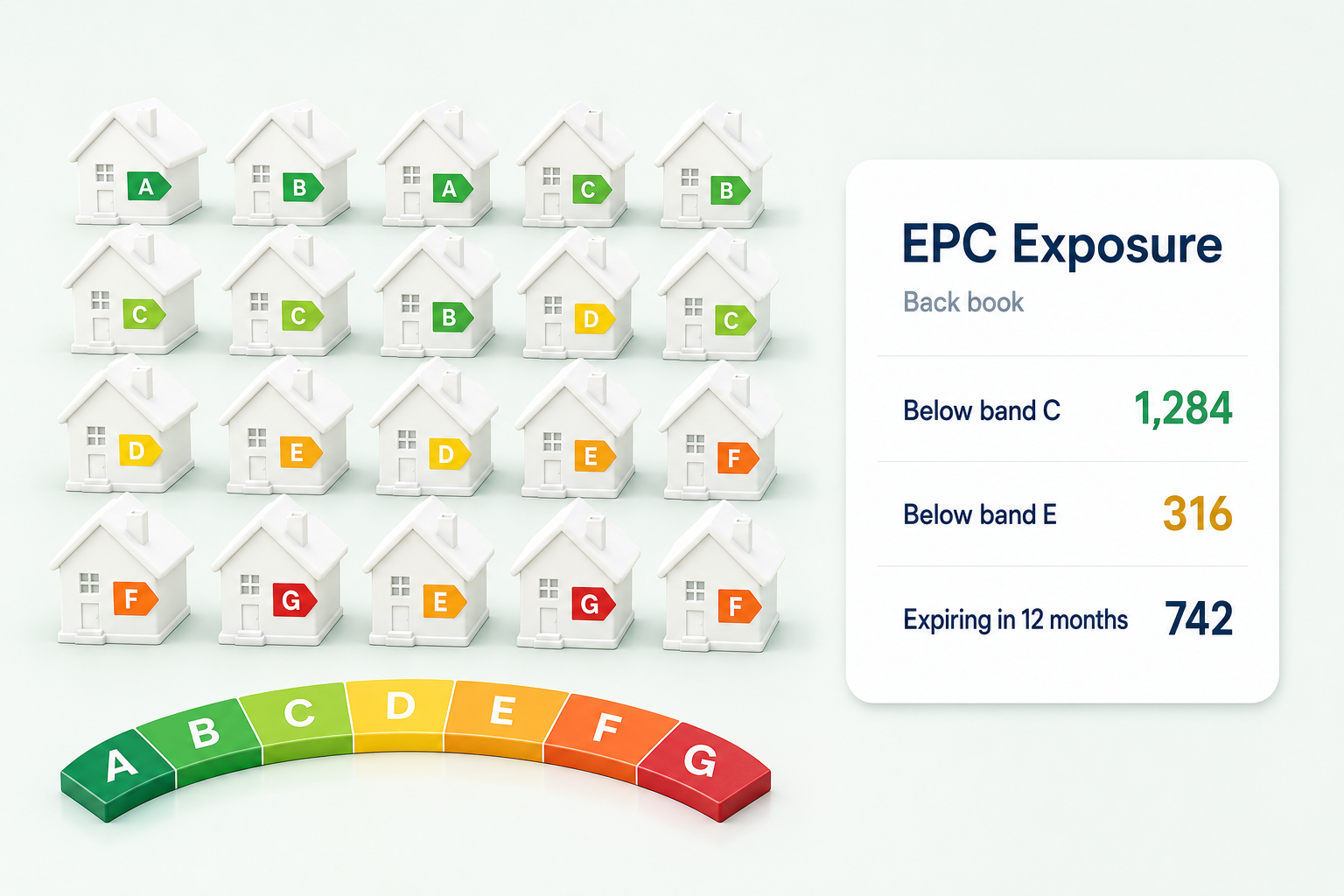
The exposure question resolves into counts a risk function can actually act on. First, the assets below C, which is where the private rented minimum standard lands on 1 October 2030. Separately, the assets already below E, which have been non-compliant for existing tenancies since April 2020. Those are two different problems, and conflating them is the common error: the F and G stock is a present breach, while the D and E stock is a remediation programme with a known deadline and a known cost cap. Second, the certificates expiring inside twelve months, where the current rating is about to become stale and the true position is unknown. Run these across the back book in a single pass and you have a numerator, not an impression.
For model validation and internal audit, a defined count against a dated source is far easier to stand behind than a rating distribution with no per-asset trail. When someone asks how many loans are exposed to MEES, the answer should be a number you can reproduce from the certificate on each property, with the expiry dates that tell you which of those numbers you can still trust.
A rating distribution describes your book. A per-asset count is the one you have to provision against.
Count the exposure, do not average it away.
Try the EPC exposure counter → · propalt.ai
EPC rating and fabric data is drawn from the EPC register and the Propalt intelligence layer. MEES thresholds, dates and cost caps are those confirmed at the time of writing; confirm the current position before relying on them. Figures shown are illustrative. This article is general information for lending risk professionals.
EPC exposure counter
Returns rating, score, expiry date and fabric detail per asset, so the back book can be counted for assets below the C standard that applies from October 2030, assets already below E, and certificates expiring inside twelve months, in one pass.
🎯 Best used for
Quantifying MEES and EPC exposure across a back book
🔌 Propalt APIs used
get_epc_fabric_by_postcode get_epc_fabric_by_property_id