On the morning of 1 May, every landlord in England woke up to a tenancy law that no longer worked the way it had the day before.
Section 21 was gone. The assured shorthold tenancy, the model that had underpinned the private rental sector for three decades, converted overnight into an open-ended periodic tenancy. No fixed term. No no-fault eviction. A landlord who wants a property back must now prove a ground under Section 8, in front of a judge, with evidence.
The Renters' Rights Act 2025 didn't creep in. It landed, and it has put every landlord in the country in front of the same choice: professionalise the way you manage your portfolio, restructure it, or sell up.
At the same moment, estate agents have started asking AI assistants the questions that used to take an afternoon of portal searches. Which landlords in my patch hold three or more properties? Which of them have not transacted in five years?
ChatGPT and Claude can answer those questions. But not on their own, and the difference between the two states is the whole story of AI landlord prospecting. This article walks through the exact prompts, step by step.
Can AI like ChatGPT or Claude find landlords?
Out of the box, neither ChatGPT nor Claude holds ownership records, portfolio data, or live market information for your outcode. A language model is trained on a snapshot of text with a fixed cutoff date. Ask an unconnected model for landlords in a specific area and it will produce an answer that reads plausibly and verifies as nothing.
That is the single biggest source of wasted effort in agent AI adoption: prospecting decisions made on generated, unverifiable output. The model is the reasoning engine. The answer is only as good as the data behind it. Which raises the real question: what data does the AI need, and where does it come from?
What data does ChatGPT and Claude need for landlord prospecting?
All AI models need live, property-level landlord data as inputs to provide accurate prospecting. This is what Propalt AI supplies: it connects Claude and ChatGPT directly to 29 million UK properties and 2.1 million active landlord records, including hidden portfolios that never appear on Rightmove or Zoopla. Each record carries the signals a prospecting decision actually needs: propensity-to-sell scores, transaction history, EPC data and area market intelligence.
There is no coding on the agent side. The connection uses MCP, the same open standard both Claude and ChatGPT support, and setting it up is a settings step comparable to linking a calendar. Your team then asks questions in plain English and gets answers from live landlord data UK wide.
The prompts: one question per manual step
Here is the manual prospecting workflow, step by step, with the prompt that replaces each step once Propalt AI is connected. Type these into Claude or ChatGPT exactly as written, swapping in your own outcode.
Step 1. Instead of trawling Rightmove and Zoopla listing by listing
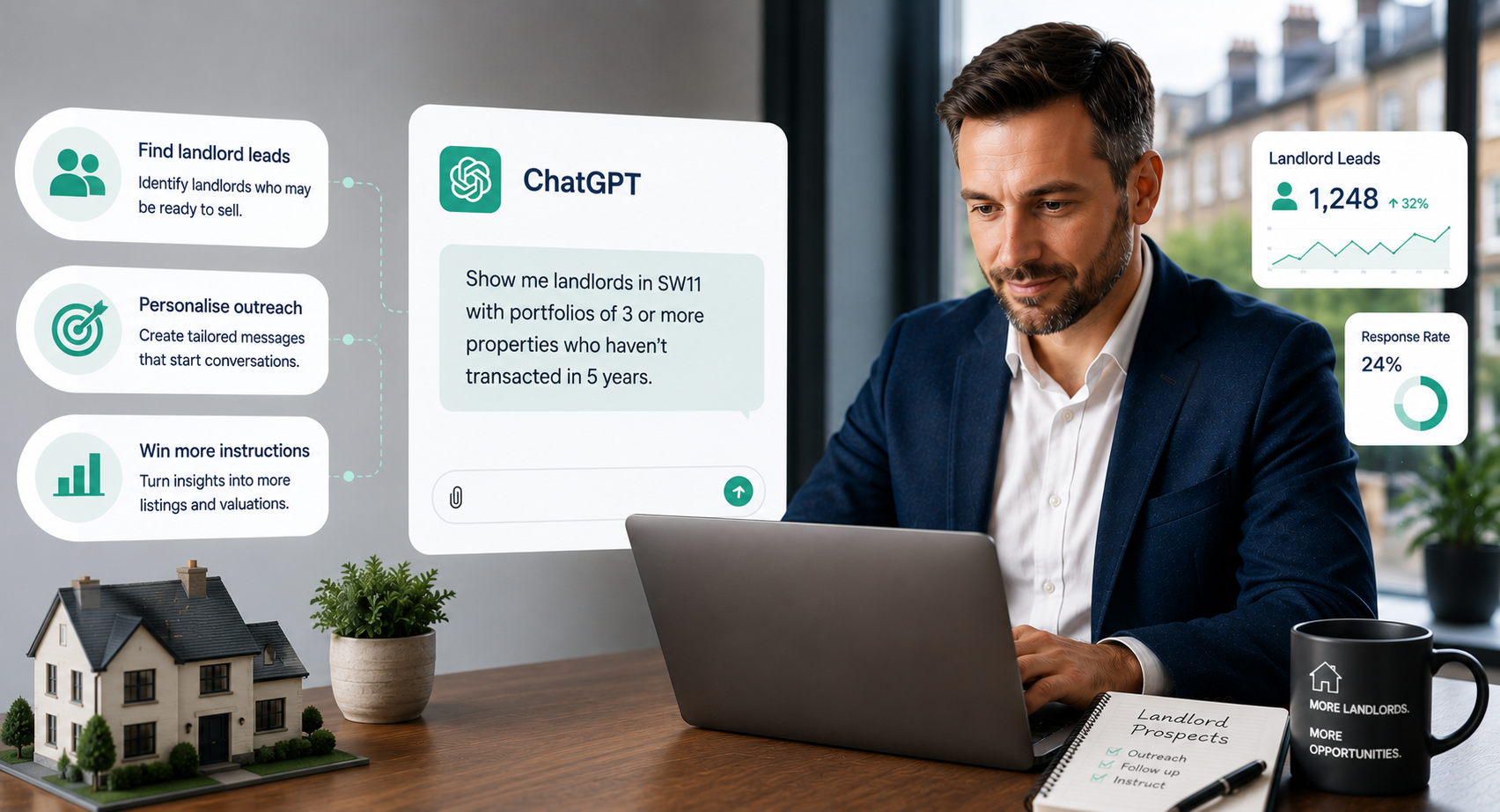
Prompt: "Show me landlords in SW11 with portfolios of 3 or more properties who haven't transacted in 5 years."
What comes back: the matching landlords, with portfolio sizes, last transaction dates and propensity-to-sell scores. Portals can only show you what is already listed. This prompt shows you the owners who have not listed yet but are statistically most likely to, which is exactly what a portal cannot do.
Step 2. Instead of cross-referencing results into a spreadsheet by hand
Prompt: "Put these landlords in a table: portfolio size, tenure split, last transaction date, average EPC rating across the portfolio, and propensity-to-sell score. Sort by score, highest first."
What comes back: a ready-made table you can paste anywhere. The afternoon in Excel becomes one sorting instruction, and the selection criteria stay visible on every row, so anyone reviewing the list can see why each landlord is on it.
Step 3. Instead of guessing which owners are landlords
Prompt: "Is 14 Elm Road, SW11 owner-occupied or privately let? If it's a landlord, show me their other holdings in this outcode."
What comes back: the tenure position of the property and, where it is privately let, the rest of the portfolio in your patch. It also works the other way round:
Prompt: "Which properties on Elm Road are part of a landlord portfolio rather than owner-occupied?"
Guesswork becomes a query.
Step 4. Instead of posting to everyone and accepting the wastage
Prompt: "From this list, give me the top 20 by propensity-to-sell, and for each one state the reason they made the cut in one line."
What comes back: a ranked, targeted list with a written selection reason against every name. Then move straight to execution:
Prompt: "Draft a letter for the top segment. Reference their long hold period and what has changed in the local market since they last transacted, without naming their exact data."
The blanket mail drop becomes a targeted send, and every contact carries a documented reason for selection. That written reason is also the answer to the "why this person" question in your GDPR legitimate interest assessment: the compliance record is a by-product of the workflow, not extra work.
The full campaign in five prompts
Strung together, a complete prospecting campaign for one outcode looks like this.
| # | Prompt | What it gives you |
|---|---|---|
| 1 | Show me landlords in [outcode] with 3+ properties, no transaction in 5 years. | The raw pool |
| 2 | Table view: portfolio size, tenure, last transaction, EPC average, propensity score. Sort by score. | The structured list |
| 3 | Top 20 with one-line selection reasons. | The targeted list |
| 4 | What is the average sold price, rental yield and time on market in [outcode] over the last 12 months? | The area evidence for your letter, and your market appraisal ammunition |
| 5 | Draft the letter. | The execution |
An afternoon spread across portals, Excel, guesswork and a mail drop compresses into one conversation. Agents running this workflow save around 4.5 hours per prospecting campaign, and it repeats for every outcode you cover. Unlike generic estate agent prospecting software, there is no new interface to learn: the interface is the AI assistant your team is already using.
"You asked your AI a question. It found 47 landlords. Your competitor is still on a portal."
What return do agents see?
For every £1 spent, clients average £10.46 back. The mechanism is not complicated: the data surfaces landlords your competitors cannot see, your letters and calls land with owners who are statistically likely to act, and more of those conversations become market appraisals and instructions. It is the same data that agents like Hunters and Northwood work with daily.
Starting costs nothing. The free tier includes 500 credits with no card required, and every endpoint is open from day one, so you can run the five prompts above on your own outcode before spending a pound.
Why is 2026 the year to start?
Because the Renters' Rights Act has forced a decision on every landlord in England, and the sector is big enough that small percentages acting means thousands of instructions. The private rented sector housed 4.7 million households in 2023-24, 19 per cent of all households in England. Ownership is concentrated: 45 per cent of landlords own a single property, while the 17 per cent who own five or more account for 49 per cent of tenancies.
The pressure is measurable. Among moderate-scale business landlords planning to shrink or leave, 81 per cent cited recent tax and legislative change as the reason. Broker data points to around 65,000 buy-to-let exits in 2023-24, with more expected through 2026.
| Date | What happened |
|---|---|
| 27 October 2025 | Renters' Rights Act 2025 received Royal Assent |
| 1 May 2026 | Commencement: no new Section 21 notices; all ASTs converted to periodic tenancies |
| 31 July 2026 | Final deadline to issue court proceedings on a Section 21 notice served before 1 May 2026 |
| Late 2026 | Private Rented Sector Database begins regional rollout; landlord registration becomes mandatory |
| 2028 (expected) | PRS Landlord Ombudsman scheme operational |
Every row in that table is a moment when a landlord weighs holding against selling. The agent who knows which landlords in their patch are at that decision point, before the board goes up, wins the market appraisal. Propalt AI is how you know first.
What are the rules when contacting landlords found through data?
The same rules that have always applied to direct marketing. Contacting landlords identified through property data must comply with the UK GDPR, the Data Protection Act 2018 and PECR, however the list was built; as HM Land Registry states in its own open data conditions, open data status does not remove data protection obligations. In practice that means documenting a legitimate interest assessment, honouring opt-outs, and being able to say where a contact came from.
The prompt workflow above helps rather than hinders: a defined list with a written selection reason against every contact is a stronger legitimate interest case than a blanket mail drop.
KEY TAKEAWAY
ChatGPT and Claude cannot prospect landlords on their own: without a data connection they produce plausible text, not records. Connected to Propalt AI, five plain-English prompts replace the whole manual workflow: find the landlords, structure the list, rank the top 20 with reasons, pull the area evidence, draft the letter. With Section 21 abolished from 1 May 2026 and tens of thousands of landlords weighing an exit, the agents who reach the right landlords first will be the ones whose AI is connected to real data. Clients average £10.46 back for every £1 spent. Start free at propalt.ai: 500 credits, no card required. Run the five prompts on your own outcode today.
Sources & data references
- MHCLG (December 2024). 'English Private Landlord Survey 2024: main report.' PRS size (4.7m households, 19%).
- MHCLG (December 2025). 'English Private Landlord Survey: Segmenting the business models of private landlords.' Portfolio concentration; 81% of moderate-scale landlords reducing cite tax and legislative change.
- MHCLG (November 2025). 'Implementing the Renters' Rights Act 2025: our roadmap.' Phased commencement, PRS Database, Ombudsman timing.
- Osbornes Law (April 2026). 'Abolition of Section 21: Key Dates.' 1 May 2026 commencement; 31 July 2026 court deadline.
- LandlordZone (December 2025). 'Rental Property Market Review 2025.' Broker estimates of c. 65,000 buy-to-let exits in 2023-24.
- Anthropic (November 2024). 'Introducing the Model Context Protocol.'
- HM Land Registry (updated 2026). 'About the Price Paid Data.' DPA and PECR obligations on direct marketing use of open data.
- Propalt AI platform data (2026). 29m UK properties; 2.1m active landlord records; £10.46 average return per £1; 4.5 hours saved per campaign.