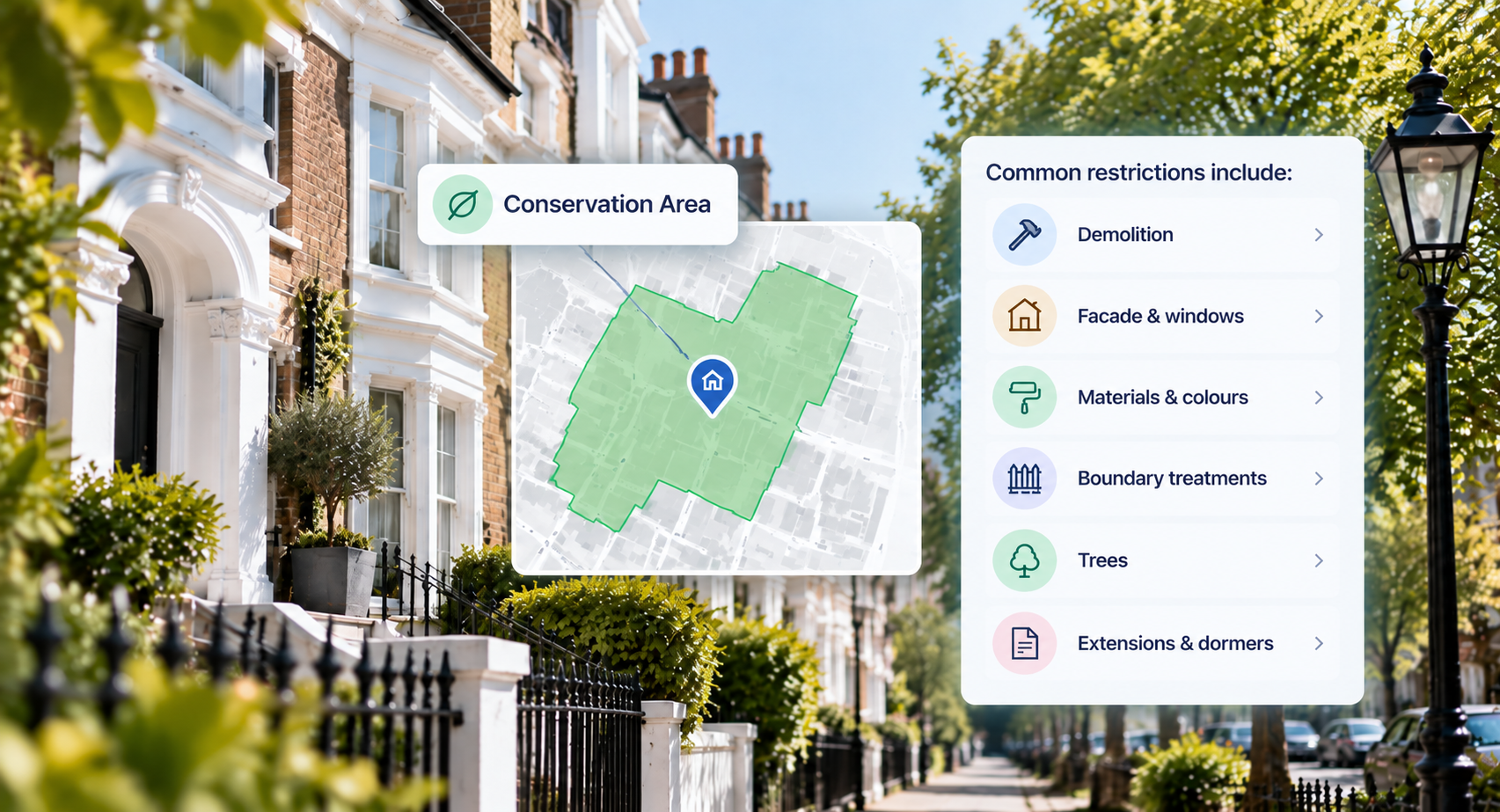
Conservation area status and listing are separate designations with separate consequences. A property can carry one, the other or both, and the combination decides what a vendor is actually allowed to do to the building.
The house is not listed. The vendor has checked, and they are right.
They can still need planning permission to demolish the garage, six weeks' notice to the council before cutting a tree back, and a full application for a dormer that would be permitted development on the next street.
Listing protects a building. Conservation area status protects an area, which is why it catches houses that are unremarkable in themselves.
The two designations run independently. A property can be in a conservation area and not listed, listed and not in a conservation area, or both at once, and each combination changes what consent is needed before work starts. Which of them applies to an address, and what each one actually stops, is worth establishing at the appraisal rather than after the offer.
What is a conservation area, and who designates it?
A conservation area is an area designated by the local planning authority under the Planning (Listed Buildings and Conservation Areas) Act 1990 as having special architectural or historic interest, the character or appearance of which it is desirable to preserve or enhance.
Two consequences follow from that wording, and both matter commercially. The designation is about the area rather than any single building, so an unremarkable house in a designated street is covered. And the authority that designates it is the same authority that decides what happens within it, which is why the detail varies from one council to the next.
What does conservation area status actually restrict?
It restricts demolition, tree work, and the range of alterations that would otherwise be permitted development. Historic England sets out the practical position for owners:
- Demolition. Planning permission is needed to demolish a building in a conservation area. Where the building is also listed, separate Listed Building Consent is required as well.
- Trees. You must give the local planning authority six weeks' notice before cutting down, topping or lopping a tree. The authority uses that window to assess the tree's contribution to the area and may respond with a Tree Preservation Order.
- Extensions and alterations. Permitted development rights differ from those outside a conservation area. Works that might not need an application elsewhere, including two storey extensions, dormer windows and stone cladding, will need one here.
The control that surprises owners most is the one they cannot see from the designation alone. An Article 4 direction, made by the local authority, withdraws specific permitted development rights within a defined area. Historic England describes these as restricting work you can normally do without planning permission, such as replacing a door or window or altering gutters and downpipes.
Designation does not stop work. It changes who decides whether the work happens, and the answer sits with the council rather than with the owner.
How is a conservation area different from a listed building?
One protects an area's character, the other protects a specific building. The practical difference is what triggers a consent requirement and how far inside the building the control reaches.
| Conservation area | Listed building | |
|---|---|---|
| What is protected | The character and appearance of a designated area | A specific building, including features that contribute to its interest |
| What is controlled | Demolition, trees, and permitted development as restricted by the designation and any Article 4 direction | Alterations affecting its character, which can include internal work |
| Consent needed | Planning permission where the works require it | Listed Building Consent, in addition to any planning permission |
| Who decides | The local planning authority that designated the area | The local planning authority, with national designation by the Secretary of State |
| Can both apply | Yes. A listed building inside a conservation area carries both sets of control | Yes |
Does conservation area status affect what you can do about an EPC rating?
It can, and this is where professionals get caught, because the energy work and the heritage control are usually assessed by different people at different times.
The measures that move a rating most in older stock are external: wall insulation, glazing, and in some cases the heating system and its flue. Those are precisely the elements a conservation area designation and an Article 4 direction are most likely to bring under control. A recommendation on an energy certificate is not a consent, and nothing on the certificate tells the reader whether the work would be permitted.
The regulatory position is moving, and it is worth stating what has actually happened rather than what is expected to. Government has confirmed its intention that privately rented homes reach EPC C, with all tenancies in scope from 1 October 2030, and has said the maximum a landlord will be required to spend is £10,000, or 10 per cent of the property value if that is lower. Exemptions confirmed include a cost cap exemption, a negative impacts exemption and a solid wall exemption.
That position was set out in a partial response to the EPC reform consultation published on 26 January 2026. The legislation itself is expected to come into force in 2027 and has not been made. Treating the 2030 date as settled law is a mistake, and so is telling a client that nothing has changed.
How do you check whether a property is affected?
Three checks, in this order, and the first two are quick:
- Check whether the property sits inside a designated conservation area. This is held by the local planning authority and is available against a property or a full postcode.
- Check whether the building is listed. This is a separate designation and a separate register.
- Check whether an Article 4 direction applies. This is the step most people skip, and it is the one that determines whether a window replacement needs an application.
The reason to do this before an appraisal rather than after one is simple. A vendor who has been told they can extend, and then discovers they cannot, does not blame the council.
Conservation area status controls demolition, tree work and the alterations that would otherwise be permitted development. Listing is a separate designation that protects a specific building and can reach inside it. Both can apply to the same property, and an Article 4 direction can withdraw further rights within a designated area.
For energy work the overlap is the part to check first, because the measures that move a rating most are the external ones most likely to be controlled. Government has confirmed its intention that privately rented homes reach EPC C for all tenancies from 1 October 2030, with a £10,000 or 10 per cent cost cap, but that came in a partial consultation response in January 2026 and the legislation is expected in 2027 rather than made.
Advice that survives contact with a planning department starts from what is designated rather than from what looks possible, and propalt.ai is built on the principle that the check should come before the conversation.
Sources and data references
- Historic England. 'Living in a Conservation Area.' Owner facing guidance on demolition, trees, permitted development and Article 4 directions. historicengland.org.uk
- Planning (Listed Buildings and Conservation Areas) Act 1990. The statutory basis for designation and for listed building consent. legislation.gov.uk/ukpga/1990/9/contents
- Town and Country Planning (General Permitted Development) (England) Order 2015. The permitted development rights an Article 4 direction withdraws. legislation.gov.uk/uksi/2015/596/contents
- Pinsent Masons, Out-Law (January 2026). 'EPC reforms and MEES for private-rented property confirmed.' Confirms the 1 October 2030 date, the £10,000 or 10 per cent cost cap, the confirmed exemptions, and that legislation is expected to come into force in 2027. pinsentmasons.com/out-law
- GOV.UK (26 January 2026). Partial response to the EPC reform consultation. The status of the position described above. gov.uk/government/consultations
- Simmons & Simmons (2026). 'The Warm Homes Plan and MEES for privately rented homes: EPC C by 2030.' Second legal source on the same position. simmons-simmons.com